Tuesday, October 12, 2010

Photostream : Hillary Clinton in Sarajevo


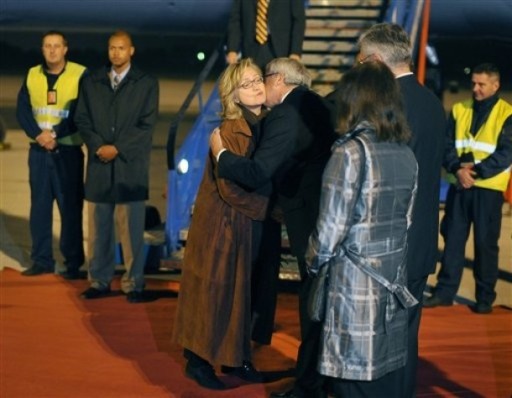
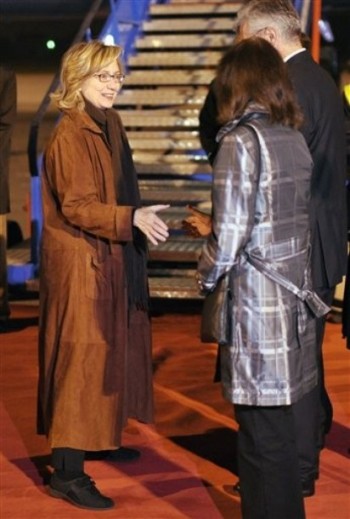
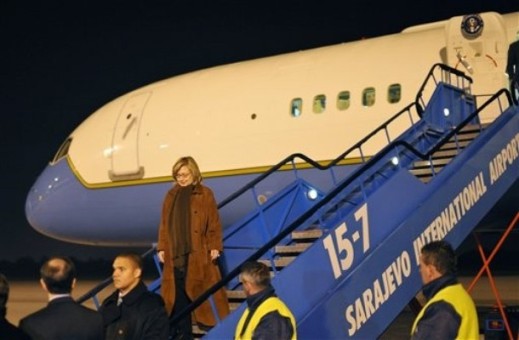
US Secretary of State Hillary Rodham Clinton on her arrival, in Sarajevo, Bosnia, Monday, Oct. 11, 2010. Secretary of State Hillary Rodham Clinton is pressing political reforms to the restive Balkans with the hope that such changes will lead to the region's full integration into the European Union and NATO. Clinton arrived Monday night in Sarajevo, the capital of ethnically divided Bosnia-Herzegovina, which just held elections, to urge the country's new leadership to make EU membership a priority. She then travels to Serbia and its now-independent former province of Kosovo to encourage the bitterly divided sides to normalize relations. (Getty Images)

US Secretary of State, Hillary Clinton waves as she walks out of airplane, upon arrival at Sarajevo airport, late on October 11, 2010. Secretary Clinton arrived in two-day visit to Bosnian capital on her tour of the Balkans. Clinton's visit to Balkans also includes visits to capitals of Serbia and Kosovo. (Getty Images)

US Secretary of State Hillary Rodham Clinton, centre left, is greeted by unidentified officials, on her arrival, in Sarajevo, Bosnia, Monday, Oct. 11, 2010. Secretary of State Hillary Rodham Clinton is pressing political reforms to the restive Balkans with the hope that such changes will lead to the region's full integration into the European Union and NATO. Clinton arrived Monday night in Sarajevo, the capital of ethnically divided Bosnia-Herzegovina, which just held elections, to urge the country's new leadership to make EU membership a priority. She then travels to Serbia and its now-independent former province of Kosovo to encourage the bitterly divided sides to normalize relations. (Getty Images)

US Secretary of State Hillary Rodham Clinton, left, on her arrival, in Sarajevo, Bosnia, Monday, Oct. 11, 2010. Secretary of State Hillary Rodham Clinton is pressing political reforms to the restive Balkans with the hope that such changes will lead to the region's full integration into the European Union and NATO. Clinton arrived Monday night in Sarajevo, the capital of ethnically divided Bosnia-Herzegovina, which just held elections, to urge the country's new leadership to make EU membership a priority. She then travels to Serbia and its now-independent former province of Kosovo to encourage the bitterly divided sides to normalize relations. (Getty Images)

Kosovars walk near a billboard with a photo of U.S. Secretary of State Hillary Clinton, in Pristina October 11, 2010. Clinton travels to the Balkans on Monday, seeking to buttress the fragile peace that was one of her husband's chief foreign policy achievements as president. Clinton will urge reconciliation for Bosnia, Serbia and Kosovo, which battled through the collapse of Yugoslavia in the 1990s and dominated the news when former U.S. President Bill Clinton was in office. (Getty Images)

Photostream : U.S. Defense Secretary Robert Gates in Hanoi

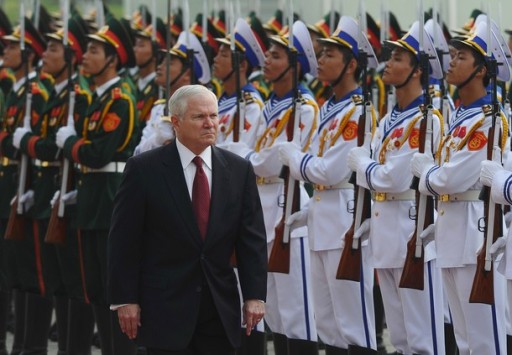
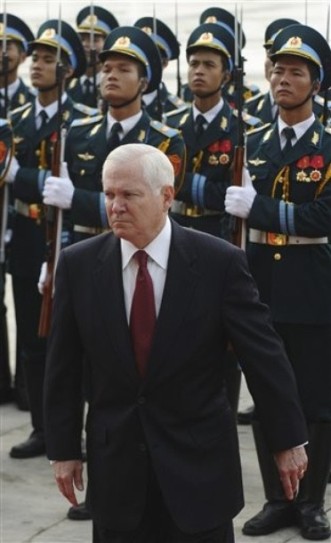
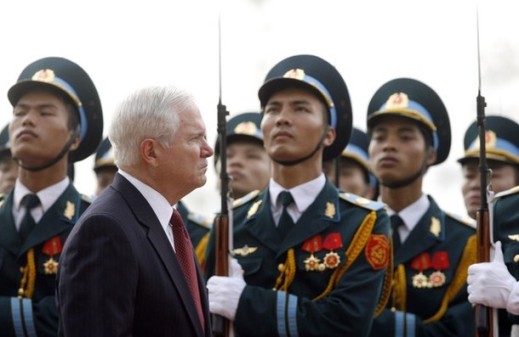
US Defense Secretary Robert Gates reviews an honour guard during a welcoming ceremony prior to the opening of the ASEAN (Association of Southeast Asian Nations) Defense Ministers meeting with their main counterparts in Hanoi on October 12, 2010. (Getty Images)
U.S. Defense Secretary Robert Gates reviews an honor guard during a welcoming ceremony prior to the opening of the ASEAN (Association of Southeast Asian Nations) Defense Ministers meeting with their main counterparts in Hanoi, Vietnam Tuesday, Oct. 12, 2010. (Getty Images)
U.S. Defense Secretary Robert Gates reviews the guard of honor during the welcoming ceremony at the National Convention Center before the first Association of Southeast Asian Nations (ASEAN) Defence Ministers Meeting Plus in Hanoi October 12, 2010. (Getty Images)
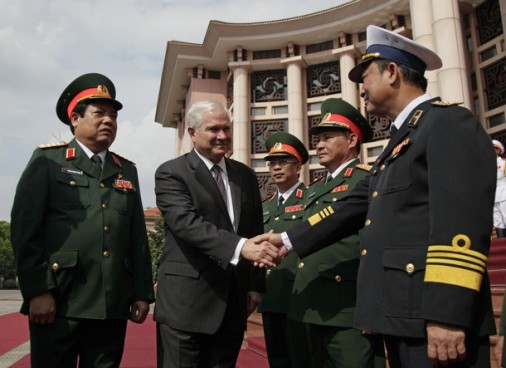
Vietnam's Minister of Defense General Phung Quang Thanh (L) introduces U.S. Defense Secretary Robert Gates (2nd L) to (from right) Admiral Hien, Lt. Gen. Khue , and Lt. Gen. Nguyen Chi Vinh on October 11, 2010 at the Vietnam Ministry of Defense in Hanoi, Vietnam. Gates is in the region to attend a meeting of defense ministers from around the Asia-Pacific region. (Getty Images)
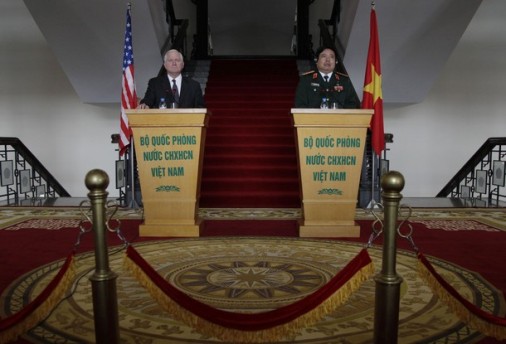
U.S. Defense Secretary Robert Gates,(L) and Vietnam's Minister of Defense General Phung Quang Thanh during a press conference at the Vietnam Ministry of Defense on October 11, 2010 at the Vietnam Ministry of Defense in Hanoi, Vietnam. Gates is in the region to attend a meeting of defense ministers from around the Asia-Pacific region. (Getty Images)
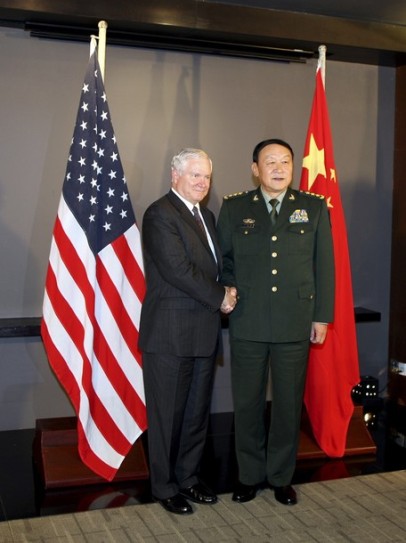
China's Defense Minister Liang Guanglie (R) and US Defense Secretary Robert Gates pose for a photo before their meeting in Hanoi October 11, 2010. Liang and Gates are in Hanoi for the first ASEAN Defence Ministers Meeting Plus this week. (Getty Images)

Photostream : Russia’s President Dmitry Medvedev meets California Governor Arnold Schwarzenegger

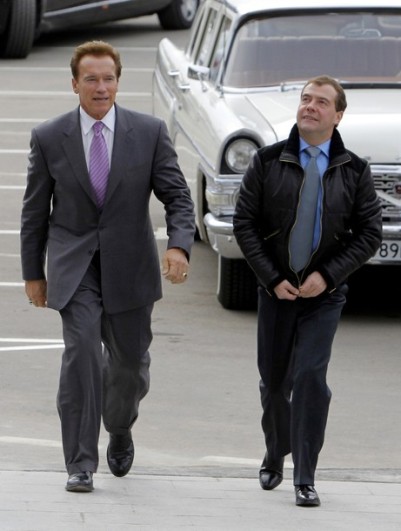
Russian President Dmitry Medvedev (R) and California governor Arnold Schwarzenegger (L) walk during their visit to Skolkovo outside Moscow on October 11, 2010. (Getty Images)
Russia's President Dmitry Medvedev (R) gives California Governor Arnold Schwarzenegger a ride in a vintage Soviet-era Chaika automobile at the presidential residence Gorki outside Moscow, October 11, 2010. (Getty Images)
Russia's President Dmitry Medvedev (L) gives California Governor Arnold Schwarzenegger a ride in a vintage Soviet-era Chaika automobile at the presidential residence Gorki outside Moscow, October 11, 2010. (Getty Images)
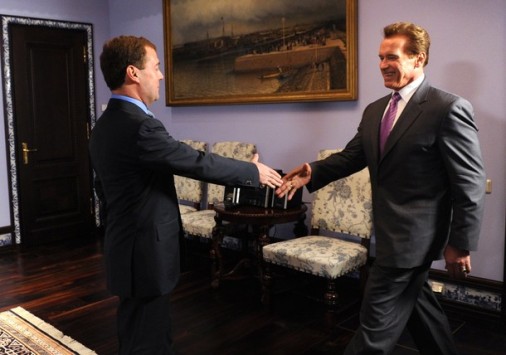
Russia's President Dmitry Medvedev (L) shakes hands with California Governor Arnold Schwarzenegger at the presidential residence Gorki outside Moscow, October 11, 2010. (Getty Images)
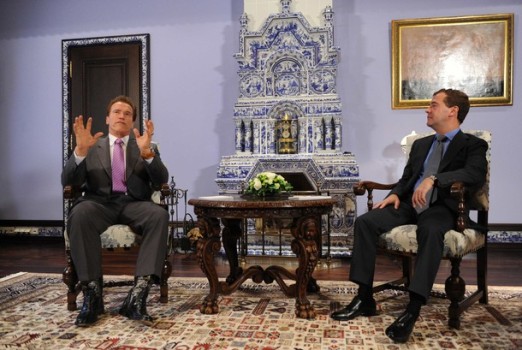
Russia's President Dmitry Medvedev (R) meets with California Governor Arnold Schwarzenegger at the presidential residence Gorki outside Moscow, October 11, 2010. (Getty Images)

Cameron: British Hostage May Have Been Killed by US Grenade

Britain's Prime Minister David Cameron gestures during a press conference in Downing Street in London, where he said aid worker Linda Norgrove, 36, who died in Afghanistan during a rescue attempt, may have been killed by her American rescuers, rather than her Taliban captors, 11 Oct 2010


October 11, 2010 (KATAKAMI) --- U.S. and British officials in Afghanistan are investigating the death of a kidnapped British aid worker killed during a rescue attempt Friday in eastern Kunar province.

British Prime Minister David Cameron said Monday that Linda Norgrove, captured on September 26, may have been accidentally killed by the troops trying to save her, and not her Taliban captors, as initially reported.


Linda Norgrove died as American Special Forces attempted to rescue her from a compound in Kunar Province in eastern Afghanistan. Initial reports claimed Norgrove was killed when her captors triggered an explosion near her.

Mr. Cameron says he has received different information from the commander in Afghanistan, General David Petraeus.

"General Petraeus has since told me that review has revealed evidence to indicate that Linda may not have died at the hand of her captors as originally believed," he said.

Mr. Cameron says American forces may have been involved.

"That evidence and subsequent interviews with the personnel involved suggest that Linda could have died as a result of a grenade detonated by the task force during the assault, however this is not certain and a full U.S.-U.K. investigation will now be launched," he said.

VOICE OF AMERICA ( VOA)

PM Netanyahu’s Speech at the Opening of the Knesset Winter Session


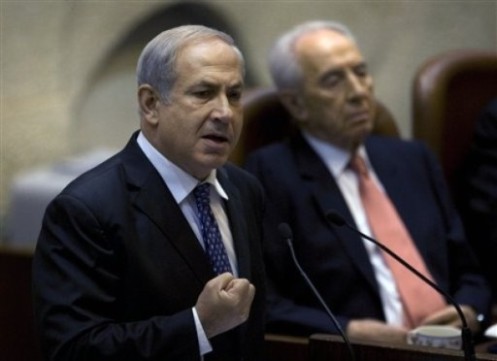
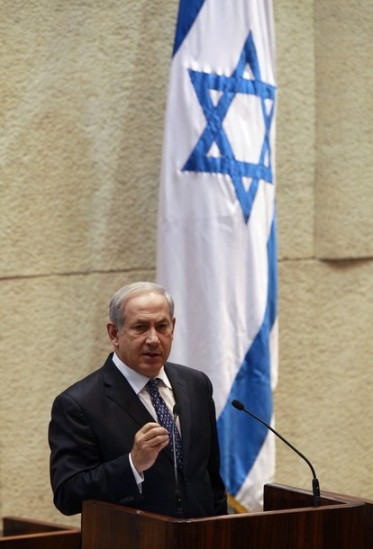
Israel’s President Shimon Peres, right, listens, as Prime Minister Benjamin Netanyahu speaks at the opening of the winter session in the Knesset, Israel’s parliament, in Jerusalem, Monday, Oct. 11, 2010. (Getty Images)


October 11, 2010 (KATAKAMI / PRIME MINISTER’S OFFICE) — It is not by chance that the portrait of the State visionary, Benjamin Zeev Herzl, hangs here, on the wall of the Israeli Knesset.  In 1896, Herzl wrote in his book, “The Jewish State”: “The Jews who are seeking a state will have a state.  Finally, we will live as free people on our own land.”

I mentioned these things at the beginning of yesterday’s Cabinet meeting, along with several other key sentences from the history of our country, and because of their importance, I would like to repeat them here at the opening of this session of the Knesset of Israel.

In 1947, 51 years after Herzl, on the eve of the establishment of the State of Israel, David Ben-Gurion wrote in his diary: “The state that will be established will be Jewish in its purpose, designation and objective; not a state of those Jews who reside in the country but a state for the Jews, for the Jewish People.”

In 1992, in the Basic Law: Human Dignity and Liberty, the Knesset determined the following: “The purpose of this Basic Law is to protect human dignity and liberty, in order to establish in a Basic Law the values of the State of Israel as a Jewish and democratic state.”

Members of Knesset,

The State of Israel is, therefore, both the nation-state of the Jewish people and a democratic country for all its citizens, Jews and non-Jews alike, enjoying full equal rights.

There is no country in our region that protects the individual rights of its citizens and the rights of their minorities like Israel’s democracy does.

The Zionist movement established an exemplary democracy and established an exemplary nation-state, a country that balances the national needs of our people with the individual rights of each and every one of Israel’s citizens.

There is no other democracy in the Middle East, and there is no other Jewish state in the world.
The combination of these two values – a Jewish state and a democratic state – expresses the foundation of our existence and the essence of the State of Israel.

I will expand on this point later on.

My fellow Members of Knesset,

During the Knesset Winter Session, we will continue dealing with the great tasks the State of Israel faces.
We intend to pass a second two-year budget in the State of Israel.

We succeeded in returning the economy to the path of growth and stability.  An additional two-year budget will help us continue these trends.

We are moving forward with the transportation revolution, developing a road and train network in the Galilee and the Negev.  You all travel the nation’s roads.  You see this revolution taking shape, the tremendous amount of work being carried out in order to connect the South and the North and to ease traffic jams in the center of the country.

We are beginning to implement the land reform, as a result of which hundreds of thousands of families in Israel will move from leasing their apartments and homes to full ownership of them.

We will continue to advance legislation regarding the planning and construction reform in order to finally alleviate the bureaucratic complications that hinder the increase in the supply of land, and which provide a constant incentive to practice nepotism and corruption.

The land reform, the planning and construction reform and the work being carried out in transportation will provide additional growth of between one and two percent per year, and I believe even more, to the GNP.  This means that we will have the resources to invest in the national needs that rightly interest the members of this house, especially two needs: security and education.

We are launching a program to rehabilitate education, including higher education, in Israel.  Higher education in Israel is in desperate need of resources.  Within six years, we will add NIS 7.5 billion to higher education.

This year, we will establish four centers of excellence at the universities out of the eventual 30 that will be established over the next several years.  These centers will gather together the most brilliant minds in Israel and abroad.  We are dealing with what is called “returning and nurturing minds” in the fields of the future, four in particular that we decided to focus on: finding fuel alternatives; the computer- and cyber-world; brain research; and unlocking the genetic code in order to cure diseases.

We are beginning to adapt the elementary education system to the 21st century.  In the next two years, teleprocessing systems will be introduced into 900 elementary schools in the North and South, with an overall investment of NIS 420 million.

We are not only teaching excellence, but also Zionism.  We are beginning the project to restore 150 heritage sites.  We have already begun work on historic sites in Jerusalem, Tel Aviv and on kibbutzim, including: at the cemetery near the Kinneret where the poets Rachel and Naomi Shemer are buried; and in the auditorium where the Declaration of Independence was presented, on Rothschild Boulevard in Tel Aviv.


Israel’s Prime Minister Benjamin Netanyahu addresses the opening of the winter session of parliament in Jerusalem October 11, 2010. Netanyahu offered on Monday to renew a partial settlement construction freeze in exchange for Palestinian recognition of Israel as a Jewish state. (Getty Images)


I will visit these two places in the next week.  All Israeli children should visit them.  As always, knowing our past is the key to our future.  However, there is a need to deal with the pressing problems of the present as well.

During the Winter Session, we will begin erecting the land obstacle in the south to prevent the massive infiltration of illegal job-seekers, something that threatens that character and identity of the State of Israel.  This is a necessary step to preventing the country from being flooded by parties that undermine our economy, as well as the unique structure we have built here.

In the coming months, we will begin implementing the urban policing plan in order to promote law and order in all areas of the country, first and foremost in Lod.

Last week, I visited Lod.  I heard the Jewish and the Arab residents beg for protection from crime families and from violence.  They want to send their children to school without fear; they want to go out in the evening without fear for their lives.

They’re right.  Every Israeli citizen – Jew and non-Jew – deserves to enjoy personal safety.
Soon the Government will hold a special meeting in Lod.

We already decided to set up a web of cameras there and make it the pilot in the City Without Violence Project.  We did these two things in nearby Ramla, and vandalism and violence was reduced by approximately 50%.

At the same time, we will begin investing in developing infrastructure in the non-Jewish sector, investing an overall amount of NIS 800 million.  We will invest an additional NIS 250 million in order to create special programs encouraging the non-Jewish sector to acquire higher educations.
As we promised, we are making significant changes to the economy, society, infrastructure, education and domestic safety.

We will, of course, continue to do so and we will continue in our efforts to return our kidnapped soldier, Gilad Shalit, to his family and to his people.

Now, Members of Knesset, I will move on to the political arena.

From the first day of the Government’s tenure, I called on the leaders of the Palestinian Authority to enter into direct peace talks with us without preconditions.

In my speech at Bar-Ilan University, I outlined the principles for a peace agreement with the Palestinians: a demilitarized Palestinian state which recognizes the state of the Jewish people and lives beside it in peace.

I believe that under the right conditions, the establishment of a Palestinian state could bring about peace, but if it is done in an irresponsible manner, the establishment of a Palestinian state could also be the cause for a worsening of the conflict and an increase in terror.

In order for the compromise to lead to peace and not war, it must be accompanied by two fundamental components: recognition and security arrangements.

When I say recognition, I mean Palestinian recognition of Israel as the nation-state of the Jewish people.  This is not just stubbornness.  This is the root of the conflict and therefore a central foundation for resolving it.

For 100 years, the Palestinians have taught entire generations to believe that there is no Jewish people, that this land is their homeland alone.

The refusal to recognize the rights of the Jewish people and its historic connection to its land is the root of the conflict, and without dealing with it, there will be no end to the conflict.

As to security, any peace agreement between the Palestinians and us must be based on strong security arrangements in the field.

We left Lebanon and Gaza without such security arrangements, and we suffered thousands of rockets fired at the Negev and the Galilee.

I am not willing to make do with peace on paper.  The citizens of Israel are also not willing to make do with that.

UN Security Council Resolution 1701 from the end of the Second Lebanon War, withdrawal from the Philadelphi Route after the Disengagement, the positioning of international forces in the North and the South – none of these things prevented the firing of thousands of missiles at Israel, and the smuggling of tens of thousands of additional missiles by Iran into hostile territory surrounding us.
I will not allow Iranian missiles to be positioned 500 meters from Kfar Saba, or scant kilometers from Ben-Gurion Airport.

We live in a small country – very small.  Our small dimensions pose existential security problems – problems that are unique to Israel.

We must not take these security problems too lightly, and we must not allow ourselves to be tempted by the illusion that a peace agreement, in and of itself, will resolve them.

We once had peaceful, normal relations, relations which included exchanges of delegations, contact between leaders, trade relations, especially of petroleum, with an important country.  That country is called Iran.

We also had wonderful, friendly relations with another country, with military cooperation, with full diplomatic relations, with visits by heads of state, with 400,000 Israeli visitors to that country.  That country is called Turkey.

I still we can rehabilitate and restore those relations, which have deteriorated against our will.  Things have changed in Iran, and unfortunately in other places as well, almost overnight, and no one can promise us that, despite our desire, a similar thing won’t happen after the establishment of a peace agreement with the Palestinians.

Therefore we must insist on strong security arrangements in the field, with determination and without fear, in order to ensure that the peace will be upheld in practice, and also in order to defend our existence in the unfortunate but possible case that the peace is violated.

Peace and security are interwoven, and they are the principles which guide me.  I firmly insist on the need for both of them, and I see that an understanding of our security needs has finally begun to penetrate international debate, beyond general statements.  I speak of our specific needs.  I believe, Members of Knesset, that if we stand together on this front, united around these principles, I am convinced it will help us achieve a peace agreement.

I believe that the unity surrounding these principles, which are so basic, so important and so real, can greatly advance our ability to achieve a peace agreement.

Although the Palestinians did not answer my call to begin direct negotiations for over a year, we took action.

We removed hundreds of roadblocks and checkpoints.  We encouraged impressive growth in the Palestinian economy – impressive by any standards, especially given the fact that at the same time the entire world was mired in recession and economic crisis.

And as you know, we also suspended new construction in the Jewish settlements for ten months.   We did so with a heavy heart.

We knew that this step would weigh heavily on our brothers and sisters, good and loyal Israeli citizens, taxpayers, participants in the Reserves, law-abiding citizens.  As the U.S. Secretary of State, Hillary Clinton, stated, it was an unprecedented move that no other government in Israel had taken before.
But we said we would do it and we did it.  We enforced the moratorium with determination and without compromise.  For ten months.

Unfortunately, the Palestinians wasted those ten months as well.

Now they demand that we continue the moratorium as a condition to continuing the talks.  I hope they are not doing so to avoid   making the real decisions necessary for a peace agreement.

Because they too will have to make difficult decisions.  I don’t belittle that.  I know what kind of decisions we will have to make, but I also know what kind of decisions they will have to make.  The only way to reach a peace agreement is to try, through direct talks, to bridge the gaps and make decisions.

However, as Prime Minister of Israel, I am committed and want to advance towards an agreement, one that will bring an end to the conflict and achieve peace between us and our Palestinian neighbors.
I know, Members of Knesset, that one can argue a great deal as to the path to achieving peace – but there is no argument that we will not achieve peace if we do not try.

During the past several weeks, I have explored every path to ensuring the continuation of the talks.  I asked myself – what could convince the government and, more so, the citizens of Israel, that the Palestinians are truly ready to live with us in peace?  What would show that there has been a genuine change on the Palestinian side – something that would demonstrate to us, the majority of the public, that they are not only demanding concessions by Israel, not only issuing dictates, but that they are ready to take a meaningful step towards us.

There is one thing.  I transmitted the message through quiet channels during the past month, and I am now saying it here, publicly: if the Palestinian leadership will unequivocally say to its people that it recognizes Israel as the nation-state of the Jewish people, I will be ready to convene my government and ask for another suspension of construction for a fixed period.

Because the Palestinians expect us to recognize the Palestinian state as their nation-state, we can expect them to recognize the Jewish state as our nation-state.

I am not insisting that this recognition serve as a precondition for talks.  We will continue the negotiations in any event, without any conditions.

However, there is no doubt that such a move by the Palestinian Authority would serve as a trust-building step, one that would open up a new horizon of hope and trust among broad sections of the Israel public who, in light of the events of the past decade, have lost their confidence in the Palestinian’s desire to end the conflict.

Unfortunately, so far the Palestinians have not answered this call, and the United States is attempting other means to ensure that the talks take place.

The United States has made various suggestions, and we are seriously and responsibly considering them, in accordance with Israel’s national interests, first and foremost security.
Ladies and Gentlemen,

We do not lack for difficulties and challenges, but I am convinced that we will overcome them.  We must only think of the obstacles we have overcome since Herzl expressed his vision.

The ancient Jewish people, so experienced in suffering, returned to its historic homeland at the turn of the previous century and found it destroyed, neglected and desolate, full of swamps and malaria.
For over one hundred years, we built it through sweat and blood, and we established a magnificent country.

Those reverberating words of the Declaration of Independence, read by David Ben-Gurion, still touch our souls today: “We hereby declare the establishment of a Jewish state in the land of Israel to be known as the State of Israel.”

This is the secret to our national existence, and recognition of this has always been and will always be the true foundation for peace.

Monday, October 11, 2010

French, Spanish FMs meet with King Abdullah, Abbas

President Mahmoud Abbas & King Abdullah II


October 11, 2010 (KATAKAMI) --- French Foreign Minister Bernard Kuchner and his Spanish counterpart Miguel Moratinos meet in Amman with Palestinian President Mahmoud Abbas and Jordan's King Abdullah. 

The European ministers, who met with Israeli officials on Sunday, expressed optimism vis-à-vis the peace process, and noted that they believed Europe could assist the process, especially Spain and France. 


(YNET / AFP)

Israeli FM Lieberman: Europe should fix itself first

Israel's Foreign Minister Avigdor Lieberman speaks with his French counterpart Bernard Kouchner (R) and his Spanish counterpart Miguel Angel Moratinos (L) before their meeting in Jerusalem October 10, 2010


October 11, 2010 (KATAKAMI) --- Israel's foreign minister has told visiting European foreign ministers to solve Europe's problems before taking on the Middle East.

Avigdor Lieberman's remarks came during a visit by Bernard Kouchner of France and Spain's Miguel Angel Moratinos.

Earlier, Mr Kouchner had said that the option of the UN Security Council declaring a Palestinian state could not be ruled out if negotiations failed.

The European ministers are due to meet Palestinian and Jordanian leaders.

They are in the region as part of efforts to save the Middle East peace talks, which are in danger of collapsing.

Palestinian officials say they will pull out of talks if Israel refuses to extend its partial freeze on settlement building in the occupied West Bank.
'Short shrift'
 
In an interview published on Sunday by the Palestinian newspaper al-Ayyam, Mr Kouchner said that France preferred a two-state solution to be negotiated with Israel, but added that appealing to the Security Council to resolve the conflict remained a possibility.
"We want to be able to soon welcome the state of Palestine to the United Nations... The international community cannot be satisfied with a prolonged deadlock. I therefore believe that one cannot rule out in principle the Security Council option," he said.

But he was told to mind his own business by Mr Lieberman during a meeting later on Sunday.


Mr Kouchner said that despite its problems, Europe was "an example of problem solving".

The French minister noted that Europe was comprised of 27 countries "who were at war for centuries, but which now get along".


Prime Minister Benjamin Netanyahu of Israel (C) meets with French Foreign Minister Bernard Kouchner (L) and Spanish Foreign Minister Miguel Moratinos on October 10, 2010 in Jerusalem, Israel. (Getty Images)


Following a meeting with Israeli Prime Minister Benjamin Netanyahu, he said he was optimistic about a resolution to the Palestinian-Israeli impasse over renewed Jewish settlement building in the West Bank, but said it could take time.

Palestinian leader Mahmoud Abbas has vowed that there will be no further talks until settlement activity halts.

Over the weekend, Arab League foreign ministers agreed to give the US one month to try and break the deadlock.

Israel has refused Palestinian and international demands to extend a 10-month moratorium on new settler homes that expired last month.

About 500,000 Jews live in more than 100 settlements built since Israel's 1967 occupation of the West Bank and East Jerusalem. They are considered illegal under international law, although Israel disputes this.


BBC

Medvedev takes Schwarzenegger to Russia's high-tech hub

Dmitry Medvedev and Arnold Schwarzenegger


October 11, 2010 (KATAKAMI) --- Russian President Dmitry Medvedev took California Governor Arnold Schwarzenegger on a visit to Russia's high-tech research hub outside Moscow on Monday.

Schwarzenegger arrived in Moscow at the head of a delegation of high-tech executives and venture businessmen on Sunday.

Medvedev and the California governor set off for Skolkovo, dubbed Russia's Silicon Valley, after a meeting at the president's residence at Gorki.

Schwarzenegger, who played hard-jawed Soviet narc Ivan Danko in a 1988 film Red Heat, said he never thought he would visit the Russian capital as the governor of California.

He said he was impressed by Medvedev's enthusiasm for developing innovative and "green" technologies.
Tycoon Viktor Vekselberg, who is in charge of the Skolkovo project, played down expectations that the Kremlin and Schwarzenegger-led delegation would sign "political" contracts.

He said the visit was "another step towards boosting cooperation between the U.S. and Russian companies."

Medvedev has made modernization the focal point of his agenda and is keen to bring U.S. know-how to Skolkovo. He visited Silicon Valley during his visit to the United States in June. He also met with Schwarzenegger during the trip.

GORKI (Moscow region), October 11 (RIA Novosti)

Abbas told Arab summit Israel has 'cancelled Oslo': aide


President Mahmoud Abbas attends Arab League Summit, October 09, 2010 in Sirte, Libya. (Getty Images)


October 11, 2010 (KATAKAMI / FRANCE 24 / AFP)  - Palestinian leader Mahmud Abbas told Arab leaders over the weekend that Israel has in effect scrapped the landmark 1993 Oslo autonomy accords, an aide said on Monday.

"Abbas affirmed to the Arabs that Israel has effectively cancelled the Oslo agreement and the other agreements it has signed with the Palestine Liberation Organisation (PLO)," chief negotiator Saeb Erakat told AFP.

He went on to accuse Israel of having stripped the Palestinian Authority of much of its limited powers in the occupied territories and of "intruding on a daily basis" into areas governed by the Palestinians, Erakat said.
"If Israel does not respect agreements or adhere to implementing them then how can the PLO and the Palestinian Authority adhere to them?" he asked.


The 1993 Oslo accords formally launched the peace process based on autonomy and led to the creation of the Palestinian Authority, which was to govern parts of the occupied West Bank and Gaza until a final agreement.

But after nearly two decades of sputtering talks Israel and the Palestinians remain bitterly divided on core issues and Abbas has refused to negotiate without a complete freeze of Jewish settlement building on Palestinian lands.

Erakat said that Abbas, at the Arab summit in the Libyan city of Sirte, also spelled out several alternatives to direct negotiations should Israel continue to build in the occupied territories.

One option would have the Palestinians demand US recognition of a state in the Palestinian territories occupied in the 1967 Arab-Israeli war: the West Bank, Gaza Strip and annexed Arab east Jerusalem.

Abbas said other options include demanding full membership from the UN General Assembly and the Security Council or requesting an international mandate to govern the Palestinian territories, Erakat said.

"Abbas did not say he would resign or dissolve the Palestinian Authority," Erakat said, referring to far more drastic steps to which the Palestinians have alluded in the past.

"But he said that since Israel has cancelled the Oslo accords and the other agreements and stripped the power of the Palestinian Authority over Palestinian lands, why should it remain in place?"

The latest round of peace talks was relaunched on September 2 in Washington but ground to a halt when a 10-month partial moratorium on Israeli settlements expired on September 26.

Israel's Prime Minister Benjamin Netanyahu has refused to extend the restrictions, a move opposed by much of his right-wing-led coalition, but he has encouraged the Palestinians to stick to the talks.
Click here to find out more!

PM Netanyahu's Remarks at the Start of the Weekly Cabinet Meeting ( 10/10/2010 )

OCTOBER 10: Israeli Prime Minister Benjamin Netanyahu opens the weekly cabinet meeting at his Jerusalem office on October 10, 2010 in Jerusalem, Israel. (Getty Images)


October 10, 2010 (KATAKAMI / PRIME MINISTER'S OFFICE) --- Following are excerpts from Prime Minister Benjamin Netanyahu's remarks at the start of the weekly Cabinet meeting today:

"Today, the Cabinet will discuss an amendment to the Citizenship Law, to the effect that anyone seeking to become a naturalized Israeli citizen will declare the he or she will be a loyal citizen of the state of Israel as a Jewish and democratic state.

In 1896, Theodor (Binyamin Zeev) Herzl wrote: 'The Jews who are seeking a state will have a state.  Finally, we will live as free people on our own land.'

Fifty-one years later, on the eve of independence, David Ben-Gurion wrote: 'The state that will be established will be Jewish in its purpose, designation and objective; not a state of those Jews who reside in the country but a state for the Jews, for the Jewish People."

Our Declaration of Independence says: 'We hereby declare the establishment of a Jewish State in the Land of Israel, to be known as the state of Israel.'

In 1992, the Knesset – in Basic Law: Human Dignity and Liberty – determined: 'The purpose of this Basic Law is to protect human dignity and liberty, in order to establish in a Basic Law the values of the State of Israel as a Jewish and democratic state.'

This is the essence of the Zionist vision, of the Declaration of Independence and of the structure of administration in Israel.

The State of Israel is the national state of the Jewish People and is a democratic state in which all its citizens – Jewish and non-Jewish – enjoy fully equal rights.

To my regret, today, there are those who are trying to blur not only the unique connection between the Jewish People and its homeland, but also the connection between the Jewish People and its state.

Democracy is the soul of Israel and we cannot do without it.  No one can preach democracy or enlightenment to us.  Zionism established an exemplary national state, a state that balances between the national needs of our people and the individual rights or every citizen in the country.

There is no other democracy in the Middle East.

There is no other Jewish state in the world.

The combination of these two lofty values expresses the foundation of our national life and anyone who would like to join us needs to recognize this.

Today marks the beginning of the academic year at 66 institutions of higher learning throughout Israel.  The new academic year is marked by two main issues that we have led, along with Education Minister Gideon Saar: Fostering excellence and encouraging the periphery.  This is the first time that the higher education system is opening the academic year with a multi-year plan that has been budgeted in advance for six years.  This plan encourages scientific excellence according to international standards.

In the coming year, the first four centers of excellence will be established alongside the universities.  These are the first four out of a planned 30 centers that will be established over the next six years, at an overall investment of NIS 450 million.  Each center will operate a unique program to bring back outstanding minds from abroad.  Our goal is to return to Israel Israeli scientists and researchers from the world's leading universities.

For the periphery, several weeks ago the Cabinet approved tuition payments for discharged soldiers, for their first year of study.  At the same time, this year we are increasing the number of students at colleges in the north and south of the country, and in Jerusalem.  We are also encouraging Israel's ultra-orthodox and Arab citizens' access to higher education by allocating student quotas to these sectors and financing special programs.

I would like to commend the 293,000 students.  May they have a successful, excellent and meaningful academic year."

Nobel Peace laureate's wife remains under house arrest

Lawyer hopes Nobel will help Liu Xiaobo


Octobe11, 2010. Beijing, China (KATAKAMI / CNN) -- Liu Xia, the wife of Nobel Peace laureate and Chinese dissident Liu Xiaobo, remains under house arrest in Beijing and banned from talking to friends or media, his lawyer said.

Shang Baojun also said he would try to push for Liu Xiaobo's early release, but doubted it would happen.
"The precondition for sentence reduction or parole is an acknowledgement of your crime," he said. "If Xiaobo would do that, he wouldn't have won the peace prize."

Liu Xia was taken to see her husband Saturday in a prison about 500 kilometers (311 miles) northeast of Beijing and told him of the honor.

On hearing the news, the wife later posted on Twitter.com, Liu Xiaobo began to cry and said, "This is for the martyrs of Tiananmen Square."

Despite allowing the brief meeting, Chinese authorities have cut off Liu Xia's communications with the outside world since Friday night, prompting protests from human rights organizations.
"It's absolutely outrageous," said Beth Schwanke, legislative counsel for the U.S.-based group Freedom Now.

Liu Xia's mobile phone service has been disconnected, but she resumed updating her Twitter account -- albeit intermittently -- after returning home Sunday.

Her first tweet confirmed her home confinement and that police had broken her mobile phone.
"We'll talk about the future later," she added, but has since been only retweeting others' comments and articles.

One of the items Liu Xia posted was a link to Charter 08, a manifesto calling for political reform and human rights in China co-authored by her husband, which landed him in prison for "inciting subversion of state power."

Since her husband won the peace prize, Liu Xia has gained several thousand new Twitter followers.

News of the win continues to be heavily censored across Chinese media -- in print, on air and online. The government has even blocked the peace prize section of the official Nobel Web site.

Authorities pulled the plug on international television networks -- including CNN -- when the Nobel Committee announced the winner Friday, and CNN's reports on Liu have remained blacked out.

China's state media have ratcheted up their rhetoric against the peace prize, after the foreign ministry called the choice of Liu a "blasphemy" to the prize. Most news portals carried a dispatch from the official Xinhua news agency, quoting a Russian commentator who criticized the prize as being a political tool of the West.

China Daily, the official English-language newspaper, ran a commentary that said the Nobel decision was a Western plot to contain a rising China. Another article, with the scathing headline "A Chinese traitor who received a prize is still a Chinese traitor," has circulated online.

Despite official determination to erase all positive mentions of Liu from the public domain, his victory has inspired great enthusiasm among many in China, especially in the country's nascent but fast-growing civic society,
"I felt very moved, because the award was also for all the Chinese who pursue freedom and democracy in this country," said activist lawyer Xu Zhiyong.

He said police detained at least three people for celebrating Liu's win, with several activists remaining under house arrest.

One of them is dissident Zhou Duo in Beijing. He told CNN that police officers began guarding his doors Saturday night after he returned from a dinner party in honor of Liu.

"It really shows the government's total lack of self-confidence despite the appearance of their strength," he said.

Referring to the foreign ministry's angry response, Zhou said it actually revealed Beijing's deep emotional attachment to the Nobel prizes.

"It's only a blasphemy because they consider it sacred," he said.

Already, Chinese news Web sites have started reporting on the Nobel prize in economics -- to be given out Monday -- as if nothing happened last Friday.

Kado Ciuman Mesra & Setangkai Mawar Putih Dari Isteri Untuk Ulangtahun BHD

http://matanews.com/wp-content/uploads/bambang_hendarso-590x395.jpg


Jakarta 11/10/2010 (KATAKAMI) --- Secara EKSKLUSIF, selama seharian penuh KATAKAMI.COM berada di kediaman dinas Kapolri Jenderal BambangHendarso Danuri di hari Minggu ( 10/10/2010. 

Momen penting memang terjadi yaitu Kapolri BHD berulangtahun yang ke 58.

Sengaja tulisan ini dimuat sehari setelah acara demi acara di kediaman dinas Kapolri itu berlangsung sebab kami ingin menghormati "privacy" dari Keluarga Besar Kapolri BHD.

Sang Isteri tercinta ( Nani Bambang Hendarso Danuri) mengawali hari spesial suaminya dengan sholat tahajud Minggu dinihari. 

Di tengah malam itulah ia menyampaikan ucapan selamat ulang tahun pada suaminya disertai ciuman mesra. 

Dilanjutkan pada Minggu pagi, Ibu Nani mengundang sejumlah ibu-ibu Bayangkari anggota pengajian dari Angkatan 1974 ( Angkatan kelulusan Jenderal BHD). 

Acara "Sholat Tasbih" ini menandai ulangtahun Jenderal BHD di penghujung tugasnya sebagai Tri Brata 1. 

Acara yang digelar sederhana sekali. 

Dan buah tangan yang diberikan kepada para tamu adalah mukena berwarna coklat muda. 

Siang harinya, kediaman dinas Kapolri mulai melakukan persiapan karena pada malam harinya akan digelar acara syukuran yang akan dihadiri oleh para pejabat utama dan Kapolda. 

Khusus untuk acara syukuran ini, "tuan rumah" adalah staf di Mabes Polri.


"Saya sudah ingatkan kepada Korspri (Koordinator Sekretaris Pribadi), saya tidak ikut-ikutan untuk acara makan malam. Silahkan buat dan saya akan menyiapkan makanan. Tetapi staf harus bisa meyakinkan Bapak (Kapolri) agar beliau mau "hadir" di acara ulangtahunnya. Bukan apa-apa, Bapak paling tidak mau kalau ulangtahunnya dipestakan. Bapak itu inginnya sederhana" kata Ibu Nani Bambang Hendarso Danuri kepada KATAKAMI.COM, Minggu (10/10/2010). 


http://katakamidotcom.files.wordpress.com/2010/09/kapolri-bhd-031.jpg?w=608&h=391
Foto : Kapolri BHD


Sambil menunggu acara syukuran makan malam di kediaman dinas Kapolri di Jalan Pattimura Jakarta Selatan, Kapolri BHD menerima KATAKAMI.COM di ruang kerjanya untuk sebuah wawancara eksklusif.

Wawancara eksklusif itu akan kami muat pada kesempatan berikutnya mengenai kesan dan pesan dari Kapolri BHD sepanjang ia menjabat sebagai Kapolri selama 2 tahun.


Dan pada malam harinya, acara syukuran ulang tahun Kapolri berlangsung sangat hikmat dan penuh rasa persaudaraan antar Keluarga Besar Polri. 

Acara ini dimeriahkan juga dengan penampilan trio Srimulat yaitu Tukul Arwana, Tarzan & Nunung. 

Yang cukup menarik, Kapolri BHD satu meja dengan Wakapolri Komjen Jusuf Manggabarani, Irwasum Komjen Nanan Soekarna, Komjen Imam Sudjarwo, Komjen Timur Pradopo dan Komjen Wahyono. 

Sejumlah Kapolda hadir dalam acara tersebut ( tapi tidak semua Kapolda dari seluruh Indonesia yang hadir, hanya beberapa saja yang hadir).
Kapolri memotong kue ulangtahunnya yang dihiasi dengan topi polisi dan lilin berbentuk angka 58. 

Ia memotong kue ulang tahun itu dan menyuapkan kue tersebut untuk pertama kali kepada sang isteri tercinta.


Acara yang cukup menarik adalah acara SPONTANITAS sebab dalam acara ini Kapolri menunjuk pejabat Polri untuk menyumbangkan suaranya. 

Pejabat pertama yang jadi "korban" adalah Kapolda Metro Jaya Irjen Sutarman. 

Tetapi Kapolda Metro Jaya cukup panjang akalnya. Ia meminta seluruh Kapolri yang kebetulan hadir dalam acara Kapolri maju ke depan dan ikut bersama-sama dengan dirinya bernyanyi.

http://hminews.com/wp-content/uploads/na.jpg
Foto : Komjen Nanan Soekarna dan Komjen Imam Sudjarwo


Pejabat kedua yang jadi "korban" adalah Irwasum Polri Komjen Nanan Soekarna.
Seakan tidak mau kalah dengan paduan suara dari jajaran "Kapolda" maka Nanan meminta pada pejabat utama Mabes Polri untuk maju ke depan. 

Maka majulah sejumlah perwira tinggi Polri untuk menyumbangkan suara mereka yaitu antara lain Kabaintelkam Komjen Wahyono, Kalemdikpol Komjen Imam Sudjarwo, Kabareskrim Komjen Ito Sumardi dan sejumlah pejabat utama lainnya. Kelompok paduan suara pejabat utama Mabes Polri ini menyanyikan lagu AYAH :


Untuk Ayah Tercinta
aku Ingin Bernyanyi

Walau Air Mata Di Pipiku
Ayah Dengarkanlah
aku Ingin Berjumpa

Walau Hanya Dalam Mimpi
Lihatlah Hari Berganti
Namun Tiada Seindah Dahulu
Datanglah aku Ingin Bertemu
Untukmu aku Bernyanyi
Untuk Ayah Tercinta
aku Ingin Bernyanyi

Walau Air Mata Di Pipiku
Ayah Dengarkanlah
aku Ingin Berjumpa

Walau Hanya Dalam Mimpi


Foto : Komjen Timur Pradopo

 
Sementara itu, calon kapolri Komjen Timur Pradopo juga ditodong untuk bernyanyi. 

Tak disangka-sangka, ternyata Timur Pradopo bersuara emas. 

Calon pengganti BHD ini memiliki suara yang sangat merdu.
 
Timur yang juga merupakan mantan Kapolda Metro Jaya ini membawakan lagu FIRMAN IDOL yang berjudul : KEHILANGAN.

 
Ku coba ungkap tabir ini
Kisah antara kau dan aku
Terpisahkan oleh ruang dan waktu
Menyudutkanmu meninggalkanku


Ku merasa tlah kehilangan
Cintamu yang tlah lama hilang
Kau pergi jauh karena salahku
Yang tak pernah menganggap kamu ada


Asmara memisahkan kita
Mengingatkanku pada dirimu
Gelora mengingatkanku
Bahwa cintamu tlah merasuk jantungku


Reff:

Sejujurnya ku tak bisa
Hidup tanpa ada kamu aku gila
Seandainya kamu bisa
Mengulang kembali lagi cinta kita

Takkan ku sia-siakan kamu lagi


http://www.jakartapress.com/demo/gallery/images/602/Brimob-Bangga-Jadi-Anak-Buah-BHD.jpg

Foto : Slogan KAMI BANGGA JADI ANAK BUAH JENDERAL di Markas Brimon pada perayaan ulangtahun Brimob, November 2009


Lalu Wakapolri Komjen Jusuf Manggabarani.

Yang sangat menggelikan, saat Wakapolri Jusuf Manggabarani tampil ke depan untuk menyumbangkan suaranya, ia mengatakan bahwa dirinya tidak datang sendirian.

Jusuf Mangga yang merupakan Mantan Komandan Brimob, meminta agar para Mantan Komandan Brimob yang kebetulan hadir dalam acara ulang tahun itu maju ke depan. 

Maka Jusuf Mangga tampil bersama Kepala Lemdikpol Polri Komjen Imam Sudjarwo, Irjen SY Wenas. Mereka membawakan lagu PELANGI DI MATAMU :


(Reff) : Ingin ku maki
diriku sendiri
yang tak berkutik di depanmu

Ada yang lain di senyummu
yang membuat lidahku
gugup tak bergerak

Ada pelangi di bola matamu
seakan memaksa dan terus memaksa
ada pelangi

Ada yang lain di senyummu
yang membuat lidahku
gugup tak bergerak

Ada pelangi di bola matamu
dan memaksa diri tuk bilang
Aku sayang padamu
Aku sayang padamu


http://blogwawancaraeksklusifkatakami.files.wordpress.com/2010/03/20091118kapolri2.jpeg
Foto : Kapolri BHD dan Wakapolri Jusuf Manggabarani


Dan kalau mau terus terang, koor atau paduan suara dari "KORPS BRIMOB" inilah yang suaranya paling hancur dan amburadul karena suara mereka saling kejar-kejaran. 

Tetapi para jenderal "PARA MANTAN KOMANDAN BRIMOB" ini, benar-benar sangat percaya diri walaupun suara mereka amburadul saat bernyanyi.

Kapolri BHD sangat bahagia dengan semua penampilan bawahannya yang menunjukkan kekompakan dan rasa kebersamaan yang sangat tinggi. 

Perayaan ulangtahun Kapolri BHD yang ke 58 memang cukup sederhana dan diadakan persis di penghujung masa bakti BHD pada institusi Kepolisian. 

Mulai tanggal 1 November 2010 mendatang, Kapolri BHD resmi memasuki masa pensiun.
Genap 2 tahun ia memimpin Polri dengan beragam suka dan duka. 

"Sudah banyak sebenarnya perubahan yang ke arah yang lebih baik dari institusi Polri. Jadi jangan dibilang bahwa Polri itu tidak berubah atau jalan di tempat. Polri sudah berubah" demikian yang disampaikan BHD di hadapan tamu undangan yang memenuhi kediaman dinasnya Minggu malam.

http://images.paraorkut.com/img/pics/glitters/w/white_rose-3260.gif


BHD ingin mengajak sang isteri untuk berlibur sejenak di saat ia lengser nanti.
Dan simaklah sebuah kejutan dari sang isteri di hari ulang tahun Kapolri.

Ibu Nani Bambang Hendarso Danuri memberikan setangkai mawar putih dan mengatakan pada sang suami, "Jangan takut Sayang, ada aku disini. Biarpun tak lagi jadi Kapolri, aku akan setia mendampingimu".

Ciuman mesra dan setangkai mawar putih memang menjadi hadiah dari isteri tercinta untuk Kapolri BHD.

Cucu tertua BHD yaitu Alia juga mempunyai hadiah khusus untuk sang kakek ( yang biasa dipanggilnya dengan sebutan ABAH).

"Aku gak tahu harus kasih hadiah apa buat Abah. Hadiah dari aku, rasa SAYANG aja ya buah Abah. AKu gak punya hadiah lain, aku cuma punya hadiah itu" kata Alia yang masih berumur 6 tahun ini kepada KATAKAMI.COM. 


Sementara anak sulung BHD yang bernama Hanny, juga mempunyai hadiah khusus untuk sang ayah.

"Hadiah saya untuk Bapak adalah DOA. Doa anak untuk orangtuanya sangat ampuh. Itu yang paling penting buat saya untuk diberikan kepada orangtua yaitu Doa" kata Hanny kepada KATAKAMI.COM di sela-sela acara ulangtahun Kapolri BHD pada Minggu malam. 

Selamat Ulang Tahun Bapak Kapolri. 

Salam hormat, doa dan ucapan selamat ulang tahun kami sampaikan secara tulus.


(MS)

Sunday, October 10, 2010

Karzai, Petraeus Visit South Afghanistan


Gen. David Petraeus, left, the top commander of U.S. and NATO forces in Afghanistan, and U.S. Ambassador Karl Eikenberry listen to Afghan President Hamid Karzai as he talks to Afghans in Argandab district of Kandahar province, south of Kabul, Afghanistan, Saturday, Oct. 9, 2010. (GettyImages)


October 09, 2010 (KATAKAMI) --- Afghan President Hamid Karzai and top U.S. General David Petraeus are visiting the southern province of Kandahar, where coalition forces are engaged in a major operation against the Taliban.

U.S. Ambassador Karl Eikenberry also is accompanying the Afghan president, who is expected to meet with tribal elders Saturday to rally support for his government and for international forces.

NATO and Afghan troops are trying to drive the Taliban out of its southern stronghold with a military offensive called Operation Dragon Strike.

In another development, the British Foreign Ministry says a British aid worker kidnapped in Afghanistan was killed by her captors during a rescue attempt.  Linda Norgrove and three Afghan colleagues were abducted September 26 in the eastern province of Kunar.

Foreign Secretary William Hague expressed "deep sadness" in a statement Saturday confirming Norgrove's death.

Also, a spokesman for Italy's Defense Ministry, General Massimo Fogari, says four Italian troops were killed and another was wounded in an attack in western Afghanistan.  He said the soldiers' convoy was first struck by a roadside bomb, before insurgents attacked with gunfire.

Italian Prime Minister Silvio Berlusconi said he was saddened by the "tragic ambush."

Italy has about 3,400 soldiers in Afghanistan, deployed mostly in the west.

On Friday, a bomb blast at a mosque in northern Afghanistan killed 13 people, including the governor of Kunduz, Mohammad Omar, who frequently spoke out against the Taliban and had escaped at least two previous attempts on his life.


VOICE OF AMERICA (VOA)