Showing posts with label Dmitry Medvedev. Show all posts

Friday, November 19, 2010

Manisnya Pertemuan Medvedev - Ahmadinejad Di Tengah Ambisi Nuklir Iran


Presiden Rusia Dmitry Medvedev (kiri) berjabatan tangan dengan Presiden Iran Mahmoud Ahmadinejad dalam pertemuan mereka di Baku (18 November 2010). Foto : Kremlin.Ru

Dimuat juga di  KATAKAMI.WORDPRESS.COM


(KATAKAMI 19/11/2010) -- Siapa yang tak kenal dengan nama Mahmoud Ahmadinejad ? Pria brewokan kelahiran 28 Oktober 1956 ini adalah Presiden dari Republik Islam Iran.

Saat ini ia sedang menjalankan periode kedua pemerintahannya setelah terpilih kembali pada pemilihan umum kepresidenan tahun 2009 lalu.

Berbicara soal Ahmadinejad, berarti bicara tentang ambisi nuklir Iran yang mnemancing kecurigaan dan kemarahan hampir sebagian besar negara-negara barat.

Terutama Amerika Serikat dan Israel.

Ahmadinejad adalah figur yang sangat semaunya dalam berbicara.

Ia tak pernah punya rasa sungkan atau pakem-pakem diplomasi saat berbicara dalam forum-forum internasional.

Dua bulan lalu (September 2010) dalam forum sidang terbuka Majelis Umum Perserikatan Bangsa Bangsa ( 65th session of the United Nations General Assembly ), Ahmadinejad bisa dengan seenaknya mengatakan bahwa mayoritas orang mempercayai bahwa Amerika Serikatlah yang berada di belakang serangan 11 September 2001.

Pidato yang sangat seenaknya ini menyebabkan sejumlah delegasi dalam sidang Majelis Umum PBB melakukan walkout.

Bahkan Presiden Barack Obama secara reaktif menjawab tudingan ( klaim ? ) dari Presiden Ahmadinejad dengan mengatakan bahwa tuduhan itu adalah "sesuatu yang dapat menimbulkan kebencian". 

Istilah yang digunakan Presiden Obama menjawab klaim itu adalah : "Inexcuseable, offensive" and hateful".

Tapi "kegilaan" Presiden Ahmadinejad pada Amerika tak cuma ini, beberapa bulan sebelumnya Presiden Ahmadinejad juga pernah membuat heboh lewat pernyataannya saat ia mengatakan bahwa sebenarnya Osama Bin Laden berada di Washington.

Kontan saja omongan "asal-asalan" dari Presiden Ahmadinejad ini dibantah secara keras oleh Washington.

Presiden Iran Mahmoud Ahmadinejad saat ia tiba di kota Qazvin sekitar 90 mil (140 kilometer) barat ibukota Teheran, Iran (Getty Images)

Dan Ahmadinejad seakan tak peduli pada reaksi Obama pasca pidato kontroversial di Sidang Majelis Umum PBB .

Bahkan dalam statusnya pada akun pribadinya di jejaring TWITTER, Ahmadinejad dengan cuek menuliskan sebagai berikut :

"Well, my material bombed at the UN again. This is the last I hire Michael Richards as my head speechwriter" (September 24, 2010).

Di hari yang sama, Ahmadinejad juga menyerang Perdana Menteri Israel Benjamin Netanyahu dalam wawancara di CNN.

Tidak tanggung-tanggung, Ahmadinejad menyebut PM Netanyahu sebagai pembunuh perempuan dan anak-anak.

Dan tuduhan yang sangat berani ini, dipertegas lagi oleh Ahmadinejad.

Dalam akun twitternya yang lain Ahmadinejad menuliskan sebagai berikut :


"I wasn't lying when I told CNN's Larry King that @Plaid_Netanyahu is a dictator"who should be tried for killing women and children." (September 24, 2010)

Berbeda dengan Presiden Obama, PM Netanyahu tidak mau menanggapi serangan terbuka lewat media yang dilakukan Presiden Ahmadinejad.

Bibi (panggilan Netanyahu) bagaikan "gunung es" yang barangkali menganggap omongan Ahmadinejad adalah sesuatu yang bersifat murahan dan tak perlu dijawab secara khusus,

Tetapi dalam sebuah media online di Israel, rakyat disana yang merasa perlu membela pemimpin mereka yang diserang oleh Presiden Iran menuliskan beragam komentar.

Bibi dibela oleh rakyatnya sendiri.


Perdana Menteri Israel Benjamin Netanyahu dalam pertemuannya dengan Sekjen PBB Ban Ki-moon di New York (8 November 2010). Salah satu pernyataan yang disampaikan PM Netanyahu saat ia berkunjung ke Amerika adalah cara terbaik untuk menghadapi dan mengatasi ambisi nuklir Iran adalah dengan melakukan SERANGAN MILITER. (Foto : Getty Images)

Diantaranya adalah menyayangkan CNN yang memberikan kesempatan bagi Ahmadinejad untuk diwawancarai.

Dan ada sebuah komentar berbahasa Inggris yang di muat di media online Israel HAARETZ yang singkat tetapi cukup pedas dari rakyat Israel untuk Ahmadinejad yaitu : "Look who's talking !"

Presiden Ahmadinejad memang termasuk salah seorang pengguna jejaring sosial Twitter yang cukup aktif.

Ia punya beberapa beberapa akun twitter.

Dan dalam akun twitter pribadinya yang manapun, topik yang paling sering disorot untuk diejek, disindir dan dikomentari dengan seribu satu macam "keanehan" adalah soal Amerika, Presiden Obama, Palestina dan Israel.

Tetapi Ahmadinejad juga menunjukkan "kegenitan yang sangat menggelikan" saat ia menjawab di Twitter kritikan dari sesama pemimpin dunia (dari kalangan perempuan) yaitu dari Presiden Argentina Cristina Fernández de Kirchner.

"Oh, what's that? YOU'RE A WOMAN, I CAN'T HEAR YOU! I'm not listening, lalalalalalalala"  (October 22, 2010).

Atau pesan Ahmadinejad untuk Mantan Ketua DPR Amerika, Nancy Pelosi yang harus tersingkir dari kursi jabatannya pasca kemenangan Partai Republik yang mengantarkan JOHN BOEHNER sebagai pengganti Nancy Pelosi :


"Ex-speaker Pelosi, you can still "speak" at my house anytime. (wink wink) -M.A." (November 3, 2010).

Ahmadinejad adalah anak dari pasangan Ahmad dan Khanom.

Ia adalah anak ke-4 dari 7 bersaudara.

Tak selamanya ia bersikap arogan.


Dalam foto ini diambil pada Selasa, 9 November 2010, Presiden Iran Mahmoud Ahmadinejad, kanan, menyambut Kardinal Jean-Louis Tauran, Presiden Dewan Kepausan untuk Dialog Antar Vatikan, di kantor kepresidenan di Teheran, Iran. (Foto : Getty Images)

Saat Paus Benediktus ke XVI secara tegas mengecam rencana Pendeta Terry Jones untuk membakar Al Quran pada bulan September 2010 lalu, hal ini mendapat pujian dari Presiden Ahmadinejad.

Ia menghargai Tahta Suci Vatican yang mengecam rencana gila yang provokatif tadi.

Ahmadinejad,  tumben-tumbennya bisa menuliskan pesan yang sangat santun pada akun twitternya mengenai hal itu :


"I thank Pope for condemning the Qu'ran burning which was to take place in Florida, USA not long ago. Much, much appreciated" (October 8, 2010).

Mungkin itulah sebabnya tanggal 9 November 2010 lalu, Presiden Ahmadinejad bersedia menerima kunjungan dari Utusan Paus Benediktus yaitu Kardinal Jean-Louis Tauran yang datang untuk menyampaikan surat khusus dari Paus untuk Presiden Iran.

Dan bagi Indonesia, Iran adalah negara sahabat yang selalu mendapat tempat khusus di hati sebab sama-sama memiliki latar belakang sebagai negara Islam.

Indonesia adalah negara yang berpenduduk Islam terbesar di dunia.

Indonesia tak pernah bergeser dari sikapnya jika menyinggung masalah program nuklir Iran yaitu tak setuju jika Iran dijatuhi sanksi yang sangat tidak berkeadilan tetapi Indonesia selalu mendukung secara tegas proses dialog dalam menyelesaikan krisis nuklir di Iran.


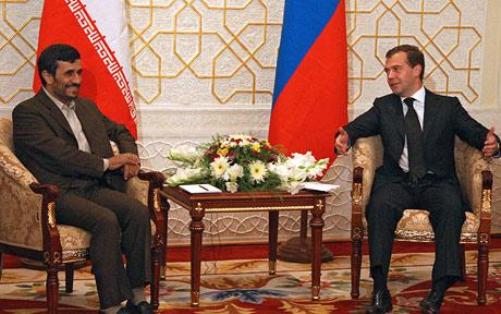
Presiden Rusia Dmitry Medvedev (kiri) dalam pertemuannya dengan Presiden Iran Mahmoud Ahmadinejad di Baku (18 November 2010). Foto : Kremlin.Ru

Dalam kunjungannya ke Baku pada pekan ini, Presiden Ahmadinejad menyerukan kepada negara-negara barat agar berhenti menekan Iran.

Desakan dari Ahmadinejad ini sangat bisa dipahami dengan akal sehat.

Bagaimana efektivitas diplomasi jika untuk menyelesaikan sebuah permasalahan yang sangat rumit semacam nuklir, jurus yang digunakan adalah jurus gertak yang sangat sinis disertai sanksi-sanksi yang sangat memusingkan kepala bagi Iran ?

Itu sebabnya, pertemuan antara Presiden Ahmadinejad dengan Presiden Rusia Dmitry Medvedev di Baku tanggal 8 November lalu sangat menyejukkan hati.

Rusia memainkan peranan yang sangat cantik dalam krisis nuklir Iran yang semakin suram.

Presiden Medvedev menyampaikan langsung kepada Presiden Ahmadinejad tentang pentingnya menjaga program nuklir di Iran sebagai sebuah program nuklir damai ( a peaceful Iranian nuclear programme ).

Pertemuan ini menjadi tolak ukur baru bahwa saat ini ada pemimpin dunia yang bisa melakukan kontak langsung dengan Iran dalam sebuah kerangka dialog yang sehat dan bersahabat.

Sikap saling serang di media-media internasional dari sejumlah pihak kepada Iran ( dan dibalas juga oleh Presiden Ahmadinejad lewat pernyataan-pernyataan yang jauh lebih "bringas" di media ) hanya akan membawa proses perundingan dalam mengatasi ambisi nuklir Iran ke lembah kekelaman.

Rusia membuktikan kemampuan mereka untuk menjadi kekuatan baru yang pantas disegani di dunia.

Lepas dari kepentingan perdagangan antar kedua negara yaitu Rusia dan Iran, tetapi Rusia juga harus selalu mengingat bahwa posisi strategis mereka ini harus tetap diarahkan pada prinsip perdamaian dan keamanan dunia yang berkelanjutan.


Perdana Menteri Rusia Vladimir Putin (kiri) dan Presiden Dmitry Medvedev. (File)

Baik Presiden Medvedev atau Perdana Menteri Putin, keduanya harus senantiasa membawa dan menempatkan Rusia sebagai tonggak yang akan selalu menjamin misi-misi perdamaian dan keamanan dunia terjaga dengan baik.

Rusia harus sangat selektif melakukan perdagangan senjata (misil) ke negara-negara manapun yang dapat menyalah-gunakan kecanggihan persenjataan itu untuk merugikan pihak lain.

Sangat menyejukkan hati saat Rusia ( lewat Presiden Medvedev ) bisa secara langsung bertemu dan berkomunikasi dengan pemimpin seradikal Presiden Ahmadinejad.

Ke depan, Rusia bisa menjadi kekuatan yang bisa mengimbangi dan meminimalisir kerasnya dorongan banyak pihak yang sudah sangat kehabisan kesabaran dan begitu geram pada Iran.

Rusia bisa menjadi pihak yang berperan maksimal untuk ikut menyelesaikan krisis nuklir di Iran, terutama jika semua saluran komunikasi dan lobi-lobi dari berbagai kekuatan diplomasi menjadi tersumbat.

Apalagi setelah bertemu dengan Presiden Ahmadinejad pada bulan November ini, Presiden Medvedev berencana untuk melakukan kunjungan ke Israel pada bulan Januari 2011 mendatang.

Topik soal Iran pastilah akan menjadi topik menarik untuk dibahas bila sudah bertemu dengan Israel.

Paling tidak, Presiden Medvedev bisa menyampaikan pada Presiden Shimon Peres dan Perdana Menteri Netanyahu agar Israel bersedia bersikap lebih "baik hati" dalam menghadapi masalah Iran.

Mau jadi apa dunia ini kalau sedikit-sedikit, serangan militer yang dijadikan langkah utama.

Mau jadi apa dunia ini kalau dalam menyelesaikan sebuah masalah penting seperti krisis nuklir ini, masing-masing negara besar dan kekuatan-kekuatan yang "super power" begitu mudah menjatuhkan sanksi demi sanksi.

Diplomasi seakan sudah tidak membutuhkan proses dialog.

Diplomasi seakan sudah tidak membenarkan proses damai.

Diplomasi, apakah pantas disebut sebagai diplomasi, jika kekuatan-kekuatan besar yang mempunyai peranan penting didunia ini sudah mengubah citra mereka menjadi singa yang siap menerkam siapa saja yang dianggap membangkang dan tak mau diatur ?

Jangan serang Iran, apalagi lewat serangan militer.

Sebab serangan itu hanya akan membuat rakyat Iran menjadi terancam dan hampir dapat dipastikan akan memakan korban jiwa yang tak berdosa dari kalangan sipil, perempuan dan anak-anak.

Dan janganlah ada arogansi-arogansi yang bersembunyi dibalik prinsip-prinsip keangkuhan sebagai negara atau kekuatan yang penuh superioritas ( super power) sehingga merasa pantas untuk menghajar negara lain.

Untuk apa ada Perserikatan Bangsa Bangsa ( UN ) Di dunia ini jika kekuatan diplomasi sudah kehilangan kekuatan-kekuatan lobi mereka yang berbasiskan perdamaian yang sesungguhnya.

Iran juga harus sangat terbuka pada kepedulian dunia internasional bahwa di zaman kekinian ancaman nuklir sebagai senjata pemusnah atau pembunuh massal adalah sesuatu yang sangat tidak dibenarkan.

Presiden Ahmadinejad juga harus mau bersikap lebih bersahabat kepada media massa asing yang ingin berkontribusi di Iran sebab para jurnalis tidak memiliki agenda-agenda propaganda yang licik.

Percayalah bahwa setiap jurnalis dan setiap media hanya membawa satu kepentingan yaitu pembawa informasi.

Please.


(MS)

Thursday, November 18, 2010

Photostream : Russian President Dmitry Medvedev meets Iranian President Mahmoud Ahmadinejad


Russia's President Dmitry Medvedev (R) walks with Iran's President Mahmoud Ahmadinejad during their meeting in Baku, November 18, 2010.
The two heads of state discussed Iran’s nuclear programme and other issues. The Russian President emphasised the importance of continuing Iran’s peaceful nuclear programme. The construction of the Bushehr Nuclear Power Plant, which was carried out by Russian specialists under IAEA control, is an example of effective cooperation in this sphere.
Dmitry Medvedev and Mahmoud Ahmadinejad also discussed issues pertaining to trade and economic ties, as well as other areas of cooperation between Russia and Iran. The meeting took place on the sidelines of the third Caspian Summit. (Getty Images / REUTERS/Dmitry Astakhov/RIA Novosti/Kremlin )

Russia's President Dmitry Medvedev (L) shakes hands with Iran's President Mahmoud Ahmadinejad in Baku, November 18, 2010. World powers should stop threatening Iran if they want to achieve results at talks on Tehran's nuclear programme, Iranian President Mahmoud Ahmadinejad said on Thursday. (Getty Images / REUTERS / Dmitry Astakhov/RIA Novosti/Kremlin )

Russian President Dmitry Medvedev (L) and his Iranian counterpart Mahmoud Ahmadinejad shake hands during their bilateral meeting on the sidlines of a regional summit in Baku on November 18, 2010. The two heads of state discussed Iran’s nuclear programme and other issues, says Kremlin. The Russian President emphasised the importance of continuing Iran’s peaceful nuclear programme. The construction of the Bushehr Nuclear Power Plant, which was carried out by Russian specialists under IAEA control, is an example of effective cooperation in this sphere. Dmitry Medvedev and Mahmoud Ahmadinejad also discussed issues pertaining to trade and economic ties, as well as other areas of cooperation between Russia and Iran. The meeting took place on the sidelines of the third Caspian Summit. (Photo by DMITRY ASTAKHOV/AFP/Getty Images)

Russian President Dmitry Medvedev (L) looks at his Iranian counterpart Mahmoud Ahmadinejad during their bilateral meeting on the sidelines of a Caspian regional summit in Baku on November 18, 2010. Iranian President was to meet Medvedev during one of the lowest points in relations between the two traditional allies. Once a reliable backer of Tehran throughout the nuclear standoff, Moscow has scrapped a controversial missile deal with Iran and backed United Nations sanctions against the country, which Russia now admits is nearing the ability to develop a nuclear bomb. (Photo by DMITRY ASTAKHOV/AFP/Getty Images)

Russian, Iranian leaders to mend rift


File photo : Russian President Dmitry Medvedev (R) shakes hands with Iranian President Mahmoud Ahmadinejad (L) during their bilateral meeting in Dushanbe on August 28, 2008

 Please also visit : KATAKAMI.WORDPRESS.COM

November 18, 2010 BAKU (KATAKAMI / CHANNEL NEWS ASIA) --- The presidents of Russia and Iran will meet in the Azerbaijani capital Baku Thursday hoping to mend an unprecedented breakdown in relations between the two traditional allies.

Russian President Dmitry Medvedev and his Iranian counterpart Mahmoud Ahmadinejad will be among the leaders of five states littoral to the Caspian Sea meeting to address overlapping claims to the sea's vast energy riches.

But bilateral talks between Medvedev and Ahmadinejad scheduled for Thursday afternoon are sure to overshadow a summit that in previous meetings has ended with little progress.

The Kremlin Wednesday confirmed the highly anticipated bilateral meeting would take place on the sidelines of the summit.

A source in the Russian delegation said Medvedev understood the importance of the meeting with Ahmadinejad.

"We believe one needs to conduct negotiations, needs to talk, to try to convince," the source said.

Analysts have billed the meeting as a last chance to repair relations that were Tehran's most significant alliance with a major world power before the current crisis.

Russian-Iranian tensions came to the boil this September when Moscow -- after repeated delays -- officially dropped plans to supply Tehran with high-precision S-300 missiles and a batch of other sensitive arms.

Iran did little to hide its displeasure with Russia's reversal. Ahmadinejad this month accused Russia of falling "under the influence of Satan (the United States)" and selling out "to our enemies."

Russia has already backed a series of United Nations sanctions resolutions against the Islamic nation and Medvedev himself has voiced a growing sense of frustration with the persistent nuclear ambitions of Tehran.

"We are convinced that under the sanctions it is necessary to look for new incentives which will ensure greater cooperativity, constant cooperation with Iran including on nuclear issues and dialogue with it," Medvedev's top foreign policy aide Sergei Prikhodko said ahead of the meeting.

"The sanctions do not cover the entire volume and complex of ties with Iran. A significant part of cooperation does not fall and will not fall under the sanctions," he added.

The Caspian summit itself -- the third gathering of nations that also includes Azerbaijan and the Central Asian states of Kazakhstan and Turkmenistan -- was unlikely to make much progress on its most important dispute: how to split up the sea.

Iran insists on dividing the Caspian into five equal portions while the Azerbaijanis are angling for access that corresponds to each country's coastline. (*)

Wednesday, November 17, 2010

Medvedev, Ahmadinejad to meet in Baku


File photo : Russian President Dmitry Medvedev [right] speaks with Iranian President Mahmoud Ahmadinejad during their bilateral meeting in Dushanbe on August 28, 2008 Photo: AFP/GETTY

Please also visit : KATAKAMI.WORDPRESS.COM

November 17, 2010 (KATAKAMI / RIA NOVOSTI) --- Russian President Dmitry Medvedev will meet on Thursday with Iranian President Mahmoud Ahmadinejad to discuss Iran's nuclear program, Kremlin aide Sergei Prikhodko said on Wednesday.

The two leaders will meet on the sidelines of the Caspian summit in Baku, Prikhodko said.

(*)

Photostream : Russian President Dmitry Medvedev meets Lebanese Prime Minister Saad Hariri


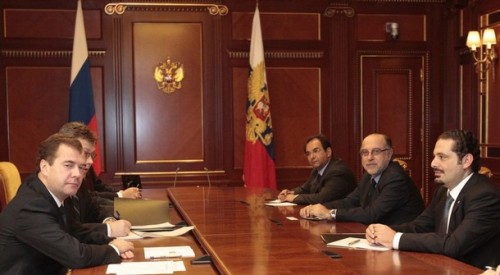
Russian President Dmitry Medvedev (R) welcomes Lebanese Prime Minister Saad Hariri (L) at the Gorki presidential residence outside Moscow on November 16, 2010. Hariri announced late on November 15 in Moscow that Russia would offer Lebanon six combat helicopters, 31 tanks and 36 artillery pieces complete with ammunition and shells. (Photo by VLADIMIR RODIONOV/AFP/Getty Images)

Russia's President Dmitry Medvedev (L) meets with Lebanon's Prime Minister Saad al-Hariri (R) at the Gorki presidential residence outside Moscow November 16, 2010. (Getty Images / REUTERS/Alexander Natruskin)

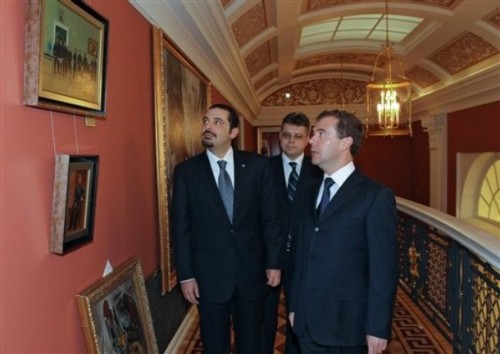
Russian President Dmitry Medvedev, right, Lebanese Prime Minister Saad Hariri, left, look at paintings during their meeting in the Gorki residence outside Moscow, Tuesday, Nov. 16, 2010. (Getty Images / AP Photo/RIA Novosti, Vladimir Rodionov, Presidential Press Service)

Russian President Dmitry Medvedev (R) and Lebanese Prime Minister Saad Hariri (L) visit the Gorki presidential residence outside Moscow on November 16, 2010. Hariri announced late on November 15 in Moscow that Russia would offer Lebanon six combat helicopters, 31 tanks and 36 artillery pieces complete with ammunition and shells. (Photo by VLADIMIR RODIONOV/AFP/Getty Images)

Japanese PM says considering visit to Kuril Islands


Japanese Prime Minister Naoto Kan

November 17, 2010 (KATAKAMI / RIA NOVOSTI) --- Japanese Prime Minister Naoto Kan said on Wednesday that a possible visit to the disputed Kuril Islands, called the Northern Territories by Japan, deserved careful consideration.

"Given how important the prime minister's visit [to the islands] is, it must be considered seriously. At the moment I do not have any concrete plans," Kan said in a speech to the Japanese parliament.

Earlier this month, Russian President Dmitry Medvedev aggravated a long-standing dispute over four of the islands, by becoming the first Russian or Soviet leader to visit one of them.

Both countries have laid claims to the islands since they were occupied by the Soviet Union at the end of World War II and the dispute has prevented them from signing a peace treaty to formally end wartime hostilities.

The Japanese premier reiterated Japan's stance on the status of the islands.

"Japan's principal position that the Northern Territories are part of our country and that the territorial dispute must be resolved through the signing of a peace treaty, has not changed," he said.

Last week Medvedev met with Kan during the APEC summit in the Japanese city of Yokohama. Medvedev invited Kan to visit "any part of Russia, including the Far East."

Kan said he "wanted to develop friendly relations between Russia and Japan on a basis of trust, as between two partners."

TOKYO, November 17

Sunday, November 14, 2010

Russia to host APEC summit on September 8-9, 2012

Russia's President Dmitry Medvedev

Please also visit : KATAKAMI.WORDPRESS.COM

November 14, 2010 (KATAKAMI / RIA NOVOSTI) — Russia will host the Asia-Pacific Economic Cooperation (APEC) summit on September 8-9, 2012, a source in the APEC secretariat said on Sunday.

“Russian President Dmitry Medvedev said at a working meeting of the APEC forum today that Russia will host the summit on the Russian Island on September 8-9, 2012,” the official said.  (*)


YOKOGAMA, November 14

Saturday, November 13, 2010

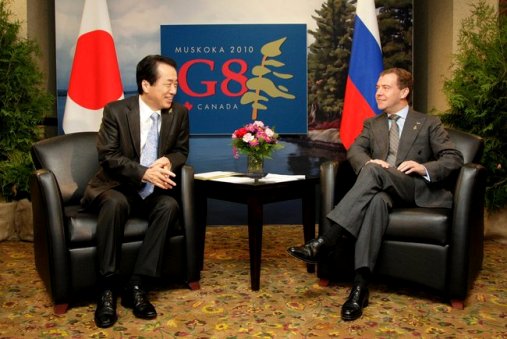
Dmitry Medvedev met with Naoto Kan on the sidelines of the APEC Summit


Russian - Japanese Talks
November 13, 2010 (KATAKAMI / KREMLIN.RU) --- The leaders of Russia and Japan stated their commitment to developing a dialogue based on trust between the two countries. 

One of the main subjects under discussion was the Kuril Islands." to visit any Russian region, including the Far East, and the Japanese Prime Minister accepted the invitation.


* * *


PRIME MINISTER OF JAPAN NAOTO KAN (retranslated): Mr President, as you pointed out, the Asia-Pacific region is the centre of global economic development. The region has the highest economic growth rate in the world.

I would like to deepen the friendly relations based on partnership and trust between Japan and Russia and will make every effort to achieve this aim. This is our second meeting and I hope that today’s talks will mark the beginning of a full-scale dialogue between us based on mutual trust.

PRESIDENT OF RUSSIA DMITRY MEDVEDEV : Mr Prime Minister, first of all, I would like to thank you once again for the excellent organisation of the APEC Summit. This is indeed our second meeting and I hope that during these talks and in the course of other contacts we will lay the foundation for a dialogue based on trust between our states. (*)

Friday, November 12, 2010

Medvedev to meet with Japanese leader during APEC summit


Russia's President Dmitry Medvedev walks onto the podium, in front of Japan's Prime Minister Naoto Kan, prior to a family photo session at the G20 Summit in Seoul November 12, 2010. The G20 will agree to setting vague "indicative guidelines" for measuring global imbalances and hammer out the details next year, G20 sources said on Friday, effectively calling a timeout to let tempers cool after heated debate over currencies.(Getty Images / REUTERS/Yonhap/Pool )

Please also visit : KATAKAMI.WORDPRESS.COM

November 12, 2010 (KATAKAMI / RIA NOVOSTI) --- Despite the recent diplomatic spat between Moscow and Tokyo, Russian President Dmitry Medvedev will meet with the Japanese premier during the forthcoming APEC summit, Medvedev's spokeswoman confirmed on Friday.

The Russian leader is to meet with Japanese Prime Minister Naoto Kan on the sidelines of the Asia Pacific Economic Cooperation (APEC) summit to be held on November 13-14 in Yokohama. Kan said last week he was not sure if the meeting with Medvedev would go ahead.

"The Japanese side traditionally raises the issue of the Kuril Islands at such meetings. Russia's position remains unchanged," Natalya Timakova said.

A long-standing territorial dispute between Moscow and Tokyo over the Kuril Islands, called the Northern Territories by Japan, was aggravated by a recent visit by Medvedev to one of the islands. Tokyo has described the visit, the first trip by a Russian president to the disputed islands, as "regrettable," while Moscow argued it is up to the Russian authorities to decide on their trips inside the country.

Following the row sparked by Medvedev's visit, Japan temporarily recalled its ambassador from Russia. The ambassador was to return to Moscow on Sunday as the Japanese government decided to refrain from further actions of protest.

SEOUL, November 12 (RIA Novosti)

Thursday, November 11, 2010

Photostream : Australian Prime Minister Julia Gillard meets with Russian President Dmitry Medvedev in Seoul


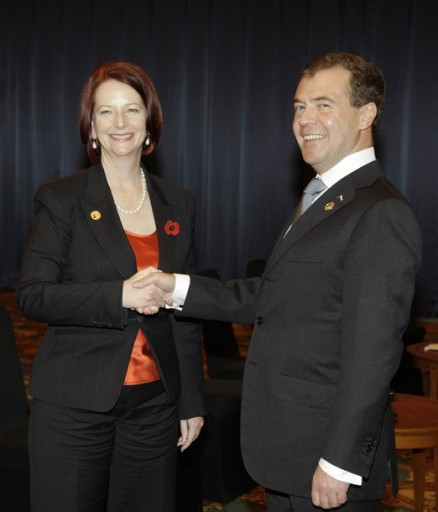
Russian President Dmitry Medvedev, right, greets Australian Prime Minister Julia Gillard before their meeting on the sideline of the G20 summit in Seoul, South Korea, Thursday, Nov. 11, 2010. (Getty Images / AP Photo/RIA Novosti, Dmitry Astakhov, Presidential Press Service)

Russia's President Dmitry Medvedev (R) meets with Australian Prime Minister Julia Gillard as part of the G20 Summit in Seoul, November 11, 2010. (Getty Images / REUTERS/Dmitry Astakhov/RIA Novosti/Kremlin )

Russian President Dmitry Medvedev, right, meets with Australian Prime Minister Julia Gillard on the sideline of the G20 summit in Seoul, South Korea, Thursday, Nov. 11, 2010. (Getty Images /AP Photo/RIA Novosti, Dmitry Astakhov, Presidential Press Service)

Russia's President Dmitry Medvedev (R) meets Australia's Prime Minister Julia Gillard as part of the G20 Summit in Seoul, November 11, 2010. (Getty Images / REUTERS/Dmitry Astakhov/RIA Novosti/Kremlin )

Photostream : British Prime Minister David Cameron meets with Russia's President Dmitry Medvedev in Seoul


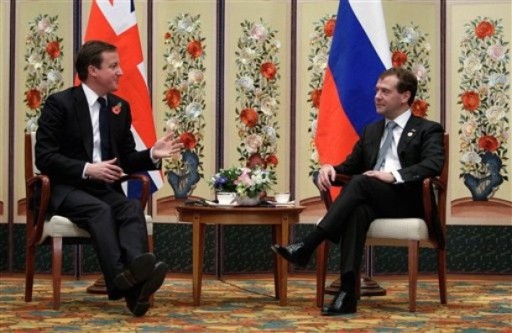
Russia's President Dmitry Medvedev (3rd L) arrives for a meeting with British Prime Minister David Cameron before the G20 summit in Seoul, November 11, 2010. World leaders are gathering in Seoul on Thursday and Friday for the Group of 20 summit aimed at safeguarding the global economic recovery and defusing trade and currency tensions. (Getty Images / REUTERS/Darren Staples )

Russian President Dmitry Medvedev, right, greets Britain's Prime Minister David Cameron before their meeting on the sidelines of the G20 summit in Seoul, South Korea, Thursday, Nov. 11, 2010. (Getty Images / AP Photo/RIA Novosti, Dmitry Astakhov, Presidential Press Service)

Russian President Dmitry Medvedev, right, meets with Britain's Prime Minister David Cameron on the sideline of the G20 summit in Seoul, South Korea, Thursday, Nov. 11, 2010. (Getty Images / AP Photo/RIA Novosti, Dmitry Astakhov, Presidential Press Service)

Britain's Prime Minister David Cameron (L) meets with Russian President Dmitry Medvedev before the G20 summit in Seoul, November 11, 2010. World leaders are gathering in Seoul on Thursday and Friday for the Group of 20 summit aimed at safeguarding the global economic recovery and defusing trade and currency tensions. (Getty Images /REUTERS/Darren Staples )

Russian President Dmitry Medvedev, right, meets with Britain's Prime Minister David Cameron on the sideline of the G20 summit in Seoul, South Korea, Thursday, Nov. 11, 2010. (Getty Images / AP Photo/RIA Novosti, Dmitry Astakhov, Presidential Press Service)

Wednesday, November 10, 2010

Dmitry Medvedev arrives in Seoul on official visit


Russian President Dmitry Medvedev

November 10, 2010 (KATAKAMI / RIA NOVOSTI) --- Russian President Dmitry Medvedev has arrived in Seoul, where he will hold bilateral talks with his South Korean counterpart Lee Myung-bak and take part in a G20 summit.

During their two-day talks, Medvedev and Lee will discuss cooperation between the countries in the energy, space, shipbuilding, fishing and military spheres during Medvedev's visit to Seoul, Russian presidential aide Sergei Prikhodko said.

More than twenty documents, including a roadmap on Russian gas supplies to South Korea, are expected to be signed during the talks, the second meeting between Medvedev and Lee in the past two month.
The two leaders are going to discuss the diversification of economic cooperation between the countries, particularly by increasing exports of hi-tech equipment.

"The parties intend to begin drawing up a joint partnership program aimed at modernization and innovative development," Prikhodko said.

Telecommunication, banking, the commercialization of innovative technologies, and environmental protection have been named as spheres of strategic cooperation between the countries, he added.
The issues of regional cooperation, especially in Siberia and the Far East, are also on the agenda, Prikhodko said.

Medvedev and Lee are also expected to address the North Korean nuclear issue during their talks.
The Russian president told South Korean media on the eve of his visit to Seoul that implementation of three-party projects between Russia and South and North Korea would help normalize the situation on the Korean Peninsula.

The construction of a pipeline to pump Russian gas via North Korea, linking the Trans-Korean Railroad with the Trans-Siberian Railway and the construction of an electricity transmission line between Russia and South Korea are among such projects. However, Medvedev said the implementation of such projects will only be possible if "tensions reduce on the Korean Peninsula and if the two Koreas follow the path of national reconciliation."

"We would like to give an additional impetus to negotiations on the implementation of large-scale infrastructure projects," Prikhodko said. "Direct support of the South Korean authorities will certainly be very important."

Lee and Medvedev last met in Moscow in 2008, when the two presidents agreed to step up bilateral cooperation, including in international effort to resolve tensions on the Korean Peninsula.

MOSCOW, November 10 (RIA Novosti)

Tuesday, November 9, 2010

Finland supports visa-free travel between Russia, EU

Russia's President Dmitry Medvedev (R) talks with his Finland's counterpart Tarja Halonen at the Gorki presidential residence outside Moscow November 8, 2010. (Getty Images / REUTERS / Mikhail Klimentyev/RIA Novosti/Kremlin )
November 09, 2010 (KATAKAMI/ RIA NOVOSTI) --- Finland supports the bilateral cancellation of visa requirements between Russia and the European Union, the country's president Tarja Halonen said on Tuesday.

Moscow has made visa-free travel between Russia and the EU a foreign policy priority.

"Finland is among the EU states that support a visa-free regime," she said. "The European Union and Russia should agree on practical measures required to make progress on the issue, quickly and with regard to all issues, including security."

Russia submitted a draft agreement on scrapping the visa regime to the EU at the Russia-EU summit in the southern city of Rostov-on-Don on May 31.

Foreign Minister Sergei Lavrov rebuked the EU in late September for dragging its heels on the issue, saying that Russia wanted a "clear answer."


MOSCOW, November 9 (RIA Novosti)

Photostream : Finland's President Tarja Halonen meets Russian President Dmitry Medvedev


Finland's President Tarja Halonen inspects the guard of honour during a welcoming ceremony at Moscow's Vnukovo airport November 8, 2010. Tarja Halonen visits Russia for talks with President Dmitry Medvedev and Prime Minister Vladimir Putin. (Getty Images / REUTERS/Alexander Natruskin )

Finland's President Tarja Halonen puts her gloves on upon her arrival at Moscow's Vnukovo airport November 8, 2010. Halonen visits Russia for talks with President Dmitry Medvedev and Prime Minister Vladimir Putin. (Getty Images / REUTERS / Alexander Natruskin )

Russia's President Dmitry Medvedev (R) talks with his Finland's counterpart Tarja Halonen at the Gorki presidential residence outside Moscow November 8, 2010. (Getty Images / REUTERS / Mikhail Klimentyev/RIA Novosti/Kremlin )

Russia's President Dmitry Medvedev (R), his Finnish counterpart Tarja Halonen (C) and her spouse Pentti Arajarvi meet at the Gorki presidential residence outside Moscow November 8, 2010. (Getty Images / REUTERS / Mikhail Klimentyev/RIA Novosti/Kremlin )

Russia's President Dmitry Medvedev (2nd R) and his wife Svetlana (R) welcome Finland's President Tarja Halonen (2nd L) and her spouse Pentti Arajarvi at the Gorki presidential residence outside Moscow November 8, 2010. (Getty Images / REUTERS/Alexei Nikolsky/RIA Novosti/Kremlin )

Dmitry Medvedev, Tarja Halonen have informal meeting


Russia's President Dmitry Medvedev (2nd R) and his wife Svetlana (R) welcome Finland's President Tarja Halonen (2nd L) and her spouse Pentti Arajarvi at the Gorki presidential residence outside Moscow November 8, 2010.

MOSCOW, November 8 (KATAKAMI / Itar-Tass) -- Russian President Dmitry Medvedev and Finnish President Tarja Halonen had an informal meeting in Moscow on Monday, November 8.

Halonen has arrived in Russia on a state visit.,

“The schedule of Tarja Halonen’s state visit began with an informal meeting with Dmitry Medvedev,” the presidential press service said. “The leaders exchanged greetings and conversed briefly, after which the head of the Russian state invited his Finnish colleague to an informal supper.”

“The wife of the Russian president, Svetlana Medvedev, and the husband of the Finnish head of state, Pentti Arajarvi, participated in the conversation along with the presidents,” the press service said.

On Tuesday, the presidents will continue negotiations in an official setting. They will meet in a narrow circle first and will be joined by members of their delegations later on.

Medvedev and Halonen will speak about the results of the talks at a joint press conference.  (*)

Sunday, November 7, 2010

Japan to return its recalled ambassador to Moscow Sunday


Japanese Ambassador to Russia Masaharu Kono

November 07, 2010 (KATAKAMI/ RIA NOVOSTI) --- Japan's ambassador to Russia Masaharu Kono, recalled amid the recent diplomatic spat over the disputed Kuril Islands, will return to Moscow by Sunday noon, the Kyodo news agency said.

On Monday, Russian President Dmitry Medvedev became the first Russian president to visit one of the four disputed Kuril Islands, called the Northern Territories by Japan. The move triggered an angry response from Tokyo, which called the visit "regrettable" and temporarily recalled its ambassador to Russia for consultations.

The Japanese government has later taken a decision to refrain from further actions of protest.
Both Moscow and Tokyo have laid claim to the Kuril Islands since they were occupied by the Soviet Union at the end of World War II. The dispute over the islands has prevented Russia and Japan from signing a peace treaty to formally end World War II hostilities.

MOSCOW, November 7 (RIA Novosti)

Friday, November 5, 2010

Russian President thanks Japan PM for invitation to APEC summit


File photo : Prime Minister of Japan Naoto Kan ( left) with Russian President Dmitry Medvedev (June 26, 2010)

November 04, 2010 (KATAKAMI / KREMLIN.RU) --- President Dmitry Medvedev sent a response message to Prime Minister of Japan Naoto Kan thanking him for the invitation to take part in the 18th APEC Economic Leaders’ Meeting in Yokohama on November 13–14, 2010.
The Russian President’s message reads, in part:

“I fully share the belief in APEC’s importance in expanding multilateral political and economic cooperation in the Asia-Pacific region as part of the effort to find effective responses to modern challenges.

I intend to actively participate in discussions on the main theme of Japan’s presidency, Change and Action. I hope that the forum will prompt its participants to adopt a set of joint measures to overcome the effects of the global financial crisis and to develop an optimal model of APEC region’s development in the post-crisis period with an emphasis on economic and social security.

I am confident that the summit will make a tangible contribution to sustainable growth of the economies participating in the forum.”


(MS)

Thursday, November 4, 2010

Meeting of Russian President Dmitry Medvedev with NATO Secretary General Anders Fogh Rasmussen


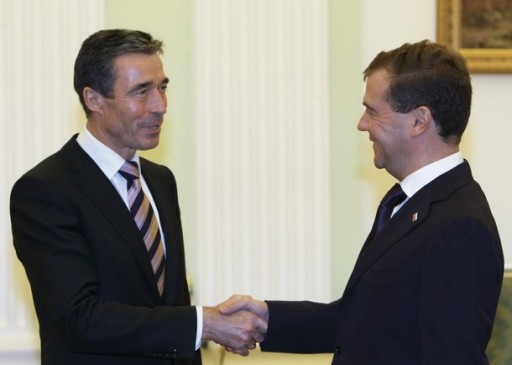
Russian President Dmitry Medvedev (R) welcomes North Atlantic Treaty Organization (NATO) Secretary-General Anders Fogh Rasmussen during their meeting in Moscow on November 3, 2010. Rasmussen said on November 3 that the alliance and Russia must bury the ghosts of the past at an upcoming summit, as he sought to persuade Moscow to join a missile defense system.  (Photo by VLADIMIR RODIONOV/AFP/Getty Images)

November 03, 2010 (KATAKAMI / KREMLIN.RU) --- Dmitry Medvedev and Anders Fogh Rasmussen discussed the current state and perspectives of Russia-NATO relations.
The President noted during the meeting that relations between Russia and NATO have gained in substance and become more productive of late, which creates opportunities for building a more solid security system in Europe and the world.

Russia’s delegation at the meeting included Foreign Minister Sergei Lavrov, Defence Minister Anatoly Serdyukov, and Russia’s Permanent Representative to NATO Dmitry Rogozin.

* * *


PRESIDENT OF RUSSIA DMITRY MEDVEDEV: Mr Secretary General, it is a pleasure to see you and wish you welcome.

I want to start by saying that relations between Russia and NATO have gained in substance and become more productive of late. We welcome this, as it creates opportunities to work harder on building up our cooperation and developing a more solid security system in Europe and the world.

We will discuss the current situation today, but I hope that later, at the summit in Lisbon, we will have the chance to talk about key cooperation areas between Russia and NATO. You know that I have decided to attend this summit, and I think it will be a useful event.

Once more, I wish you welcome to the Kremlin.

NATO SECRETARY GENERAL ANDERS FOGH RASMUSSEN:
Thank you very much, Mr President. I’m really happy to be in Moscow once again. I’m pleased that you accepted my invitation to attend the NATO-Russia Council meeting in Lisbon on the 20th of November. Now I look very much forward to a productive meeting and I’m here to prepare that meeting jointly, to make sure that it will be a productive meeting, that we will see concrete results from that meeting.
I share your view that we have seen substantial progress in our relationship during recent months. And I would very much like to develop our cooperation further. I think that summit in Lisbon will represent a fresh start for our relationship, a modernization of our relationship. And I think there is scope for further development of practical cooperation in the coming years.

November 3, 2010, 17:00The Kremlin, Moscow

Medvedev, Qatari emir discuss economic, regional cooperation


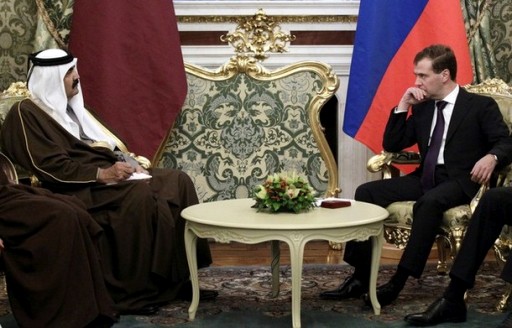
Russian President Dmitry Medvedev (R) meets with Qatar's Emir Sheikh Hamad bin Khalifa al Thani in Moscow's Kremlin, November 3, 2010. (Getty Images / REUTERS / Ivan Sekretarev/Pool )

MOSCOW, November 3 (KATAKAMI / Itar-Tass) - Russian President Dmitry Medvedev has met with Qatar’s Emir Sheikh Hamad bin Khalifa al Thani for talks on economic cooperation and regional interaction.

“Russian-Qatari relations develop successfully. Recently they have become more dynamic and mutually advantageous,” Medvedev said on Wednesday.

The Russian president proposed to discuss “economic relations between our countries and regional interaction”. Medvedev also said the Qatari emir “had interesting meetings in Russia”. “I’m sure that your stay in Russia will be intensive and fruitful,” he added.

Al Thani stressed that Qatar “seeks to develop economic cooperation with Russia”. The Qatari emir said he “had interesting meetings with Russian Prime Minister Vladimir Putin and Gazprom CEO Alexei Miller. All meetings were positive. We also discussed cultural relations due to Russia’ s heritage. We also want to develop relations in this field”. “As for our international cooperation, it is developing. I believe that it is necessary to focus more attention to the Palestinian problem,” the Qatari emir stressed.

The talks are being held at the Grand Kremlin Palace. Russia’s delegation includes Foreign Minister Sergei Lavrov and presidential aide Sergei Prikhodko. The Qatari delegation involves Prime Minister and Foreign Minister Hamad bin Jasem Al Thani.

(MS)
Tuesday, November 2, 2010

Medvedev congratulates Brazil's first female president


Russian President Dmitry Medvedev congratulates Brazil's first female president

November 01, 2010 (KATAKAMI / RIA NOVOSTI) --- Russian President Dmitry Medvedev congratulated Brazil's first female president, Dilma Rousseff, on Monday, the Kremlin said.

The ruling Workers Party's candidate was elected Brazil's president on Sunday, after winning 55.49 percent of the vote.

"Please accept my sincere congratulations on your clear-cut victory...Over the past few years we have seen tangible results in the development of friendship and cooperation between Russia and Brazil," Medvedev's message read.

Brazil's outgoing president, Lula de Silva, was first elected in 2002 and was re-elected in 2006. Under the Brazilian Constitution, the president can only be elected for two consecutive four-year terms.

D

MOSCOW, November 1 (RIA Novosti)