Showing posts with label Benjamin Netanyahu. Show all posts

Sunday, November 14, 2010

PM Netanyahu asks ministers to back 90-day settlement freeze


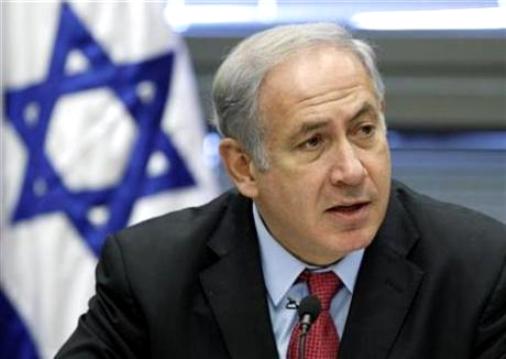
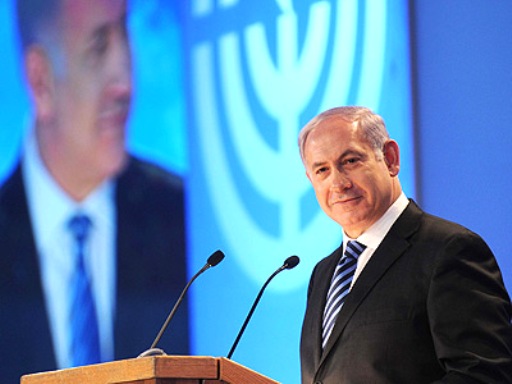
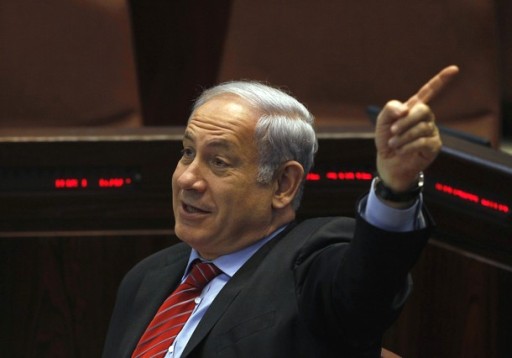
Israeli Prime Minister Benjamin Netanyahu

Please also visit : KATAKAMI.WORDPRESS.COM

November 14, 2010 (KATAKAMI / YNET) — Netanyahu convenes top government ministers for late-night session on American proposal, asks them to approve construction moratorium in West Bank in exchange for US veto on anti-Israel initiatives in UN.

The forum of top seven government ministers convened Saturday night at the Prime Minister’s Office in Jerusalem to discuss the latest American proposal for renewing direct talks between Israel and the Palestinians. 

Just a month after he vowed that construction in the West Bank would continue until the Palestinian Authority recognizes Israel as a Jewish state, Prime Minister Benjamin Netanyahu asked his ministers to approve a 90-day settlement construction freeze. 

Netanyahu apparently succumbed to the ongoing US pressure following a lengthy meeting with Secretary of State Hillary Clinton.

The US proposal presented to the ministers is premised on a construction moratorium extension for another three months. PM Netanyahu apparently reached an understanding with Washington that the building freeze would not apply to Jerusalem, and that no further moratorium would be sought following the 90-day period. 

Earlier Saturday, a close associate of PM Netanyahu hinted at the proposal, declaring that he wouldn’t “bet on a full freeze” extension to be implemented.

20 advanced fighter jets

In exchange for a freeze extension, the US would object to international attempts to force a diplomatic agreement on Israel in the UN and in other global forums, while utilizing the American veto power in the UN Security Council. 

According to the proposal, the US would also boost its resistance to the de-legitimization campaign against Israel and to attempts by Arab states to deprive Israel’s right to self-defense.

Moreover, the US Administration would ask Congress to approve the sale of another 20 advanced fighter jets to Israel worth some $3 billion. This would supplement a comprehensive future Israeli-American security agreement, to be signed alongside a peace deal, in the aims of addressing Israel’s security needs in any future treaty. (*)

Israel's Netanyahu unveils U.S. plan for new talks


Israel's Prime Minister Benjamin Netanyahu speaks during a Likud party meeting at parliament in Jerusalem October 25, 2010.
Please also visit : KATAKAMI.WORDPRESS.COM
 

November 13, 2010 (KATAKAMI / Reuters) - Prime Minister Benjamin Netanyahu showed senior ministers a U.S. plan for resuming peace talks with Palestinians, including a 90-day settlement freeze, a diplomatic source told reporters Saturday.


The plan also includes a pledge not to seek any extension to the settlement freeze after the 90-day period, a vow to veto any attempts at the United Nations to force a unilateral peace deal and an agreement on supplying Israel with more war planes.

Israeli-Palestinian peace talks, renewed under Washington's sponsorship on September 2, broke down a few weeks later when Israel balked at renewing a settlement moratorium.

Netanyahu met his top "Forum of Seven" ministers a day after returning from a week-long U.S. tour that included talks on Thursday with Secretary of State Hillary Clinton at which she unveiled the plan he showed his cabinet, the source said.

Netanyahu hopes he may win approval for the plan from his pro-settler cabinet later this week, political sources said.

Among the pledges offered to Israel by Washington, was a guarantee to veto any resolutions brought to the United Nations Security Council that seek "to impose a political settlement on Israel," the source said, speaking on condition of anonymity.

Palestinian President Mahmoud Abbas had no immediate comment. Officials speaking on condition of anonymity said the Palestinian leader was likely to wait to see whether Israel approved the ideas before issuing any comment.

AN ADDITIONAL FREEZE

Under the plan Israel would "declare an additional suspension of construction" in the West Bank, land it captured from Jordan in a 1967 war, for 90 days. Building begun since a moratorium ended in September, would be halted, the source said.

The proposed construction freeze would not include East Jerusalem, an area Israel has annexed as part of its capital in a move never recognized internationally and which Palestinians want as capital of any future state.

Washington would also undertake to veto resolutions deemed anti-Israel in the U.N. Security Council and other international organizations, the source said, a pledge that could make Israel less vulnerable to threats made by some Palestinians to declare statehood unilaterally in the event that peace talks fail.

The Obama Administration would also ask Congress to approve the supply of $3 billion worth of warplanes to Israel "to maintain its qualitative edge" in the region, the source said.

The United States would further sign a more comprehensive deal to enhance its substantial security aid to Israel as part of any agreement concluded with the Palestinians.

Israeli officials said Netanyahu, who faces a tough political sell within his own coalition on the settlement issue, had pushed Clinton for the broad understandings.

"The chances of reaching a peace agreement will be improved significantly by achieving comprehensive security understandings between Israel and the United States," Netanyahu said in New York before his talks with Clinton began. (*)

Netanyahu associate: Don't bet on full freeze


Israeli PM Benyamin Netanyahu (R) meets U.S. Vice President Joe Biden on November 7, 2010 in New Orleans, Louisiana. Netanyahu is on a five day visit to the U.S. to discuss the ongoing Mideast peace process. (Photo Avi Ohayon/GPO via Getty Images)

Please also visit : KATAKAMI.WORDPRESS.COM

Top seven government ministers scheduled to convene Saturday night, hear about PM's meeting with Clinton.

November 13, 2010 (KATAKAMI / YNET) --- Prime Minister Benjamin Netanyahu was scheduled to convene the forum of top seven ministers Saturday night in order to present US proposals and agreements secured during his meeting with Secretary of State Hillary Clinton.

The US is pressing Israel to resume direct talks with the Palestinians and extend the settlement freeze, yet a Netanyahu associate said "I won't bet on a full freeze."  


Following the US midterm elections, Administration officials have renewed the pressure on Israel, but for the time being Netanyahu has refused to extend the building moratorium.

The PM is arguing that recent construction permits issued in the territories would not affect a future peace deal.

Over the weekend, a senior opposition official told Ynet that despite rumors about progress during talks with the Americans, "Netanyahu did not finalize any agreement with us and did not engage in any negotiations in order to ensure the coalition's stability." 


A senior government official closely familiar with peace contacts told Ynet that "it's not at all certain that we'll see a breakthrough vis-à-vis the Americans – the more things progress, the more complex they become."
 
Elsewhere, the Peace Now movement is saying that the pace of construction in the territories since the end of the freeze is higher than previously reported. The group said it registered construction work on 1,649 housing units, with infrastructure already built for 1,126 such units.  

According to Peace Now, in the past month and a half the settlers almost closed the construction gap created by the freeze, and that most construction is being undertaken in isolated, relatively small settlements.   (*)

U.S. offers Israel incentives package in exchange for 3 month settlement freeze


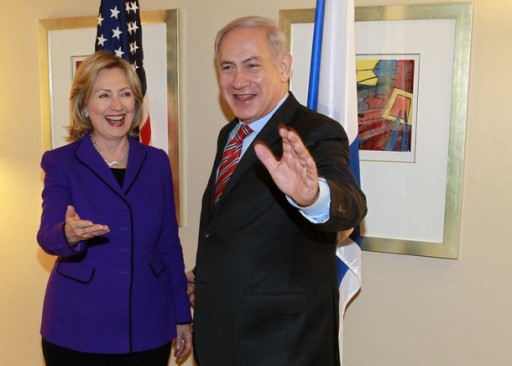
U.S. Secretary of State Hillary Rodham Clinton (L) and Israeli Prime Minister Benjamin Netanyahu pose for photographers before their meeting in New York, November 11, 2010. Getty Images / REUTERS / Brendan McDermid

Please also visit : KATAKAMI.WORDPRESS.COM

Security cabinet meets on Saturday night, receives update from Prime Minister Benjamin Netanyahu on proposed U.S. incentives package.

November 13, 2010 (KATAKAMI / HAARETZ) --- Prime Minister Benjamin Netanyahu's seven-member inner cabinet will discuss Saturday an offer by the United States to reinstate a freeze on West Bank Settlement construction in return for a package of incentives.

Netanyahu presented Saturday the U.S. offer, which was discussed by Netanyahu and U.S. Secretary of State Hillary Clinton on Thursday, to the forum of seven.

According to the offer Israel would stop construction in the West Bank for 90 days. The freeze includes construction that began after the end of the first settlement moratorium on September 26.

The moratorium would not apply to construction in East Jerusalem. The U.S. will not ask Israel to extend the new moratorium when it expires.

In return, the U.S. government would ask Congress to authorize the delivery of 20 F-35 fighter jets to Israel, a deal worth $3 billion. Moreover, if an Israeli-Palestinian agreement is achieved, the U.S. would sign a comprehensive security agreement with Israel. The U.S. and Israel are to discuss the nature of the new security arrangements in the next few weeks.

According to "The Cable" blog, White House Middle East adviser Dan Shapiro told a group of American Jewish leaders on Friday that the incentives package includes commitments to oppose anti-Israel diplomatic efforts in the international arena.

The U.S. incentives package would also include: curbing actions by the United Nations on the Goldstone Report; blocking anti-Israel UN resolutions concerning the Gaza flotilla raid; defeating international resolutions aimed at exposing Israel's nuclear program at the International Atomic Energy Agency; and strengthening pressure on Iran and Syria in regards to their nuclear and proliferation activities.

U.S.-sponsored direct peace talks between Israel and the Palestinian Authority broke down on September 26 when a 10-month Israeli freeze on settlement construction in the West Bank expired. Palestinian Authority President Mahmoud Abbas has said he would not restart negotiations with Israel while settlement construction continues. (*)

Friday, November 12, 2010

Hillary Clinton on peace talks: We will find a way forward


Israeli Prime Minister Benjamin Netanyahu (R) and U.S. Secretary of State Hillary Rodham Clinton speak with the media prior to their meeting November 11, 2010 in New York City. The two were expected to discuss the rift over settlements in Arab East Jerusalem and other Mideast peace issues. (Photo by Mario Tama/Getty Images)
Please also visit : KATAKAMI.WORDPRESS.COM

November 11, 2010 (KATAKAMI / JPOST) Prime Minister Benjamin Netanyahu met with US Secretary of State Hillary Clinton in New York Thursday, on a day when Palestinian Authority President Mahmoud Abbas told supporters at a memorial rally for his predecessor Yasser Arafat in Ramallah that "making peace is more important than anything else."

Prior to entering the meeting, Clinton and Netanyahu posed for photographs and spoke briefly to assembled press.

"The prime minister and president Abbas are both very committed to a two-state solution and we are going to find a way forward," Clinton said, according to an AFP report.


"We're going to be talking about everything and I'll be saving my comments beyond what I've already said for my talks with the prime minister," said the secretary of state.

Netanyahu responded in kind, saying he was "serious" about restarting the peace talks, which have been stalled since September following the end of the ten month settlement construction moratorium.

"We'll be talking about how to resume and continue this process to get a historic agreement with peace and security between us and the Palestinians," Netanyahu reportedly said. 

He continued: "We also hope to broaden it to many other Arab countries... we are quite serious about doing it and we want to get on with it."  (*)

Israel 'serious' on peace talks, Netanyahu tells Clinton


US Secretary of State Hillary Rodham Clinton (L) with Israel's Prime Minister Benjamin Natanyahu before their meeting November 11, 2010 in New York. US Secretary of State Hillary Clinton vowed to find a "way forward" on the stalled Middle East peace process as she began a crunch meeting Thursday with Israeli Prime Minister Benjamin Netanyahu. (Photo by STAN HONDA/AFP/Getty Images)
Please also visit : KATAKAMI.WORDPRESS.COM

November 11, 2010 (KATAKAMI / HAARETZ) --- PM vows commitment to U.S.-sponsored negotiations despite plans for new Jewish housing in West Bank.

Israeli Prime Minister Benjamin Netanyahu said on Thursday he was "serious" about talks with the Palestinians as he met with U.S. Secretary of State Hillary Clinton amid an impasse which threatens to scuttle the U.S.-backed peace negotiations. 

"We'll be talking about how to resume and continue this process to get a historic agreement with peace and security between us and the Palestinians," Netanyahu said as he began a meeting with Clinton in New York. 

"We also hope to broaden it to many other Arab countries ... we are quite serious about doing it and we want to get on with it." 

Thursday's meeting follows Israel's decision to proceed with a new housing project in part of the West Bank that it annexed to Jerusalem 43 years ago, underscoring Palestinian fears that Netanyahu's government will push ahead with settlements regardless of the impact on the peace process. 

Clinton, who on Wednesday said the Israeli decision on settlement building was counterproductive, said she still believed that both Netanyahu and Palestinian President Mahmoud Abbas were serious about the talks. 


"The prime minister and President Abbas are both very committed to a two-state solution. And we are going to find a way forward," she said. 

Israeli officials say Netanyahu intends to discuss with Clinton the need for forging broad U.S.-Israeli understandings on Israel's security needs in any eventual peace agreement in light of enormous security challenges expected in the coming decade. 

"The chances of reaching a peace agreement will be improved significantly by achieving comprehensive security understandings between Israel and the United States," Netanyahu said.
Israel wants a long-term military presence in the Jordan Valley along the eastern border of a future Palestinian state as well as financial help to pay for security arrangements that would be necessary if a peace deal is achieved. 

The New York meeting comes as the United States works to revive talks that began in Washington on September 2 but were suspended by the Palestinians three weeks later when Netanyahu refused to extend a 10-month limited building freeze in West Bank settlements. 

Netanyahu, whose governing coalition is dominated by pro-settler parties, has so far resisted calls for a freeze on settlement construction. But U.S. officials say they still hope to find a formula to revive the talks, which U.S. President Barack Obama has said could yield a deal within a year to set up an independent Palestinian state. 

With the peace process in limbo, the Palestinians have stepped up calls for the international community to move ahead and recognize Palestinian statehood now - a move the United States fears could further complicate the situation.(*)

Photostream : U.S. Secretary of State Hillary Rodham Clinton meets with Israeli Prime Minister Benjamin Netanyahu


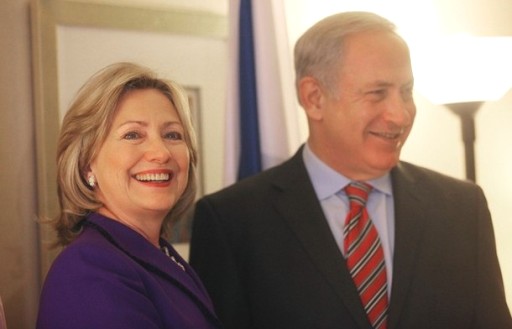
U.S. Secretary of State Hillary Rodham Clinton (L) and Israeli Prime Minister Benjamin Netanyahu pose for photographers before their meeting in New York, November 11, 2010. Getty Images / REUTERS/Brendan McDermid

U.S. Secretary of State Hillary Rodham Clinton (L) and Israeli Prime Minister Benjamin Netanyahu pose for photographers before their meeting in New York, November 11, 2010. Getty Images / REUTERS/Brendan McDermid

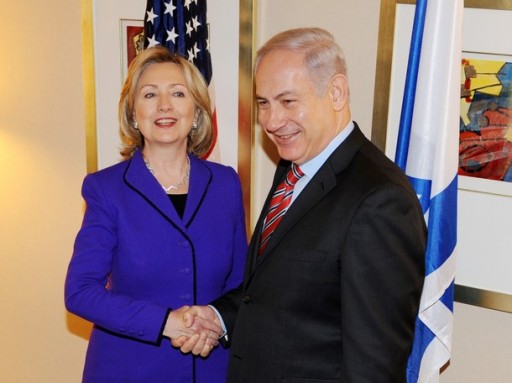
U.S. Secretary of State Hillary Rodham Clinton (L) and Israeli Prime Minister Benjamin Netanyahu meet in New York, November 11, 2010. Getty Images / REUTERS/Brendan McDermid

Thursday, November 11, 2010

Hillary Clinton, Israeli PM Netanyahu to meet amid settlement row


US Secretary of State Hillary Clinton speaks as Israeli Prime Minister Benjamin Netanyahu looks on before a meeting in Washington, DC, on August 31, 2010. The Obama administration geared up for a bold bid to relaunch direct Palestinian-Israeli peace talks and clinch a peace deal within a year as Middle East leaders arrived in Washington (Photo by JEWEL SAMAD/AFP/Getty Images)

Please also visit : KATAKAMI.WORDPRESS.COM

November 11, 2010 (KATAKAMI / THE AGE.COM.AU) --- US Secretary of State Hillary Clinton meets Israeli Prime Minister Benjamin Netanyahu on Thursday amid new strains between the two allies over Jewish settlements, further clouding hopes to renew peace talks.

Ahead of the talks, President Barack Obama and Clinton led global criticism over Israel's latest plans to build 1,300 houses in occupied east Jerusalem, where the Palestinian wish to form the capital of their future state.

Netanyahu dismissed the international response as "overblown," with his office saying on Tuesday there was "no connection between the peace process and the planning and building policies in Jerusalem."
Advertisement: Story continues below
 
Peace talks ground to a halt in September shortly after their launch when a 10-month Israeli moratorium on West Bank settlement construction expired, with the Palestinians refusing to talk until the ban is reimposed.

This week's announcement prompted Palestinian president Mahmud Abbas on Wednesday to call on the United Nations Security Council to urgently debate Israeli settlement building, again complicating the US task.

Warning against "unilateral steps" and expressing "deep disappointment" with the Israeli move, Clinton nevertheless sought to remain upbeat as Washington struggles to find middle ground that will allow to resume the peace talks.

"We still believe a positive outcome is both possible and necessary," she told a press conference in Washington.

Obama has made kick-starting the deadlocked Middle East peace process a central plank of his foreign policy and Clinton refused to give up hope.

"I remain convinced that both Prime Minister Netanyahu and President Abbas want to realize the two-state solution," Clinton said.

Netanyahu said he was going to discuss with Clinton "how to move towards a broad understanding of an agreement with the Palestinians and perhaps others in the Arab world based on security."

According to a senior Israeli official, the premier will raise "the need to reach broad understandings between Israel and the United States on Israel's security needs in a peace agreement."

Netanyahu has insisted Israel will maintain a military presence along the eastern border of the future Palestinian state.

Aaron David Miller, a Middle East expert at the Woodrow Wilson Center in Washington, said Netanyahu was likely to remain defiant.

The premier is determined "to make it unmistakably clear to the Americans that Jerusalem was never a part of this understanding and will not be a part of it in the future. There's no question that he's prepared to stand his ground," Miller told AFP.

Netanyahu believes that the Obama administration will not make settlements a "make or break issue" as they prefer to focus on the details of a future peace agreement, Miller said.

"The administration got itself on the wrong track by concentrating on settlements and not on dealing with the core issues. And now they are boxed in."

In Jerusalem, visiting US Senator John Kerry warned that the moment for Middle East peace was in danger of slipping away.

"The window of opportunity for a comprehensive peace is closing, narrowing is the best way to put it," he told reporters at a meeting with Israeli President Shimon Peres.

"This is a moment for statesmanship, it is a moment to try and define the opportunities and move forward rapidly."

(*)

PM Netanyahu: Disagreements with US 'temporary'


PM Netanyahu and Nobel Peace Prize recipient Henri Kissinger. November 10, 2010 ( Photo by Avi Ochayon GPO )

November 10, 2010 (KATAKAMI / YNET) --- Prime Minister Benjamin Netanyahu turned down the heat Wednesday and said differences of opinion between the US and Israel were "temporary." On Tuesday, the prime minister responded with unprecedented vigor to US declarations against renewed settlement construction but on Wednesday, during a meeting with senior figures from US media, he spoke in more conciliatory terms.

The "differences" reached a peak when US President Barack Obama and Secretary of State Hillary Clinton said construction in east Jerusalem was not conducive to the negotiations. Netanyahu retorted that Jerusalem is not a settlement.

During the meeting in New York, the prime minister was asked about differences of opinion between the US and Israel. He asserted that such differences were only temporary. He added that in his dealings with the US administration, he concentrated on issues that would have long-term effects on any peace agreement with the Palestinians.

Netanyahu detailed the Israeli government's position on Iran and the peace process. He is expected to meet Clinton on Thursday to discuss the need to reach wide-ranging understandings with the US about Israeli security needs in light of the significant security challenges expected in the coming decade.

He said the chances of achieving a peace deal would be much greater if security understandings could be reached with the US. He is also expected to raise the issue of peace agreements with a wider circle of Arab states in parallel to an agreement with the Palestinians.

(*)

Wednesday, November 10, 2010

PM Benjamin Netanyahu : Construction in Jerusalem


Israeli Prime Minister Benjamin Netanyahu

November 09, 2010 (KATAKAMI / PRIME MINISTER’S OFFICE) --- Jerusalem is not a settlement; Jerusalem is the capital of the State of Israel.  Israel has never accepted upon itself restrictions of any kind on construction in Jerusalem, which has approximately 800,000 residents, including during the ten months in which construction was suspended in Judea and Samaria.

Israel sees no connection between the diplomatic process and planning and building policy in Jerusalem, which has not changed in 40 years.  All Israeli governments in the past 40 years have built in all parts of the city.  During this period, peace agreements were signed with Egypt and Jordan, and for 17 years, diplomatic negotiations have been conducted with the Palestinians.  These are historical facts.  Construction in Jerusalem has never hindered the peace process.

The disagreements with the US over Jerusalem are well-known.  They are not new and have continued for 40 years.  We hope to overcome them and continue to advance the diplomatic negotiations.  Prime Minister Benjamin Netanyahu is looking forward to his planned Thursday meeting with US Secretary of State Hilary Clinton in order to advance the peace talks.  (*)

PM Netanyahu : “Jerusalem is not a settlement, Jerusalem is the capital of the State of Israel”

Israeli Prime Minister Benjamin Netanyahu


In US, Netanyahu says Israel sees no connection between peace process and construction in the capital. ‘All Israeli governments have built in all parts of the city for 40 years, and we still signed peace deals with Egypt, Jordan,’ premier adds.

November 09, 2010 (KATAKAMI / YNET) — Prime Minister Benjamin Netanyahu has toughened his stance ahead his scheduled meeting with the United States Secretary of State Hillary Clinton in Washington on Thursday, rejecting any American and international criticism regarding building in east Jerusalem.

“Jerusalem is not a settlement – Jerusalem is the capital of the State of Israel. Israel has never restricted itself regarding any kind of building in the city, which is home to some 800,000 people – including during the 10-month construction moratorium in the West Bank,” the PM said Tuesday.

“Israel sees no connection between the peace process and the planning and building policy in Jerusalem, something that hasn’t changed for the past 40 years. All Israeli governments have built in all parts of the city in the past 40 years.

“During this time,” he added, “We have signed peace agreements with Egypt and Jordan and have held negotiations with the Palestinians for 17 years. Construction in Jerusalem has never obstructed the peace process.”

Netanyahu spoke just hours after US President Barack Obama told a press conference in Indonesia that Israeli construction in east Jerusalem “is never helpful when it comes to peace negotiations.”

The Israeli premier added that “the disagreements between Israel and the US regarding Jerusalem are well-known, and I hope to overcome them and move the peace talks forward. We intend to advance the peace negotiations during Thursday’s meeting with Secretary of State Clinton.”

On Monday, the Jerusalem District Planning and Construction Committee approved the construction of 32 housing units in the eastern part of Pisgat Ze’ev, a neighborhood located beyond the Green Line.

The construction, which has been a bone of contention in the international community, was approved during Netanyahu’s visit to the United States.


(*)

Tuesday, November 9, 2010

PM Netanyahu, UN's Ban discuss peace process, Ghajar withdrawal


Israeli Prime Minister Benjamin Netanyahu (L) meets with United Nations Secretary-General Ban Ki-moon at U.N. headquarters November 8, 2010 in New York City. Israeli media reported that Netanyahu will announce the Israeli withdrawal from Ghajar, a village straddling the Lebanese-Israeli border. (Photo by Mario Tama/Getty Images)

Prime Minister Benjamin Netanyahu slams UNESCO decision to classify ancient Jewish holy site as mosque, saying 'historical facts should not be distorted in the name of politics.'

November 09, 2010 (KATAKAMI / HAARETZ) --- Israeli Prime Minister Benjamin Netanyahu and United Nations Secretary General Ban Ki-moon held talks late Monday on the stalled Middle East peace talks and the planned Israeli withdrawal from a site on the Lebanese border.

The two issued a readout of their meeting at UN headquarters in New York, according to which the "secretary general and Prime Minister Netanyahu discussed the ongoing efforts to move the Middle East peace process forward."

"The secretary general emphasized that it was vital to break the current diplomatic stalemate, resume negotiations and produce results," the statement said.

Peace talks between the Israelis and Palestinians have been stalled since September, when an Israeli moratorium on settlement activity ended. The Palestinians want the freeze extended to continue talks, and Washington has unsuccessfully tried to convince Netanyahu to do so. US President Barack Obama oversaw the relaunching of the direct Israeli-Palestinian peace talks in early September, only to see them falter once the settlement freeze expired on the 26th of the month.

Ban said he expressed concern at the resumption of the Israeli settlement activities and recent announcements of further settlement construction in East Jerusalem.

The two leaders also discussed the "current proposals on the issue of Ghajar," a reference to Israel's plan to end its occupation of the village with 2,200 inhabitants on the Lebanon-Israel border.

Haaretz had reported that Netanyahu planned to announce a withdrawal from Ghajar and the return of control of the village to Lebanon. The planned withdrawal would comply with UN Security Council resolution 1701, which ordered a ceasefire in the fighting between Hezbollah and the Israeli Defense Forces in 2006.

The two leaders also reportedly "reviewed the regional situation, including Iran," in addition to Ban's urging that Israel "ease the movement of people and goods to and from Gaza."

Netanyahu also referred to a recent controversial ruling by the UN's cultural agency, according to which West Bank heritage sites holy to both Jews and Muslims, such as Rachel's Tomb, would be considered Palestinian.

The ancient tomb, which lies between Jerusalem and the nearby Palestinian-controlled city of Bethlehem, is traditionally regarded as the burial place of a biblical matriarch and is holy to Christians, Muslims and Jews.

Speaking during his meeting with the UN chief, the PM said that the "the profound link between the Jewish people and the Tomb of the Patriarchs and Rachel's Tomb had existed for close to 4,000 years."
"Over a billion people know of this bond and it is documented in the Bible," Netanyahu said, adding that "historical facts should not be distorted in the name of politics. That would only injure the UN's stature and the way serious people around the world regard it."

Last week, Israel said it would reduce cooperation with the United Nations' cultural watchdog following the classification of Rachel's Tomb as a mosque.

Deputy Foreign Minister Danny Ayalon said Israel would not cooperate with UNESCO – the United Nations Educational, Scientific and Cultural Organization - in administering five protected sites in Palestinian territory as a dispute that has escalated in recent weeks came to a head.

Speaking with journalists in Jerusalem, Ayalon blamed the Palestinians for influencing the UN to side against Israel.

"This is another attempt at de-legitimization by the Palestinian Authority," he said.  

(*)

Photostream : Israeli Prime Minister Benjamin Netanyahu meets U.N. Secretary-General Ban Ki-moon


U.N. Secretary General Ban Ki-moon arrives with Israel's Prime Minister Benjamin Netanyahu at the United Nations Headquarters in New York November 8, 2010. (Getty Images / REUTERS/Shannon Stapleton )

Israeli Prime Minister Benjamin Netanyahu signs a guest book before meeting with United Nations Secretary General Ban Ki-Moon (out of frame) November 8, 2010 at UN headquarters in New York. (Photo by STAN HONDA/AFP/Getty Images)

Israeli Prime Minister Benjamin Netanyahu, left, greets United Nations Secretary General Ban Ki-moon at the United Nations, Monday, Nov. 8, 2010. (Getty Images / AP Photo/Kathy Willens)

Israeli Prime Minister Benjamin Netanyahu (2nd-L) meets with United Nations Secretary-General Ban Ki-moon (R) at U.N. headquarters November 8, 2010 in New York City. Israeli media reported that Netanyahu will announce the Israeli withdrawal from Ghajar, a village straddling the Lebanese-Israeli border. (Photo by Mario Tama/Getty Images)

PM Netanyahu’s Speech at the General Assembly of the Jewish Federations of North America


Israeli Prime Minister Benjamin Netanyahu speech at the annual General Assembly of the Jewish Federations of North America in New Orleans, Monday, Nov. 8, 2010.


November 08, 2010 (KATAKAMI / PRIME MINISTER'S OFFICE) --- The story of the Jewish people is that of great destruction followed by miraculous redemption. 

That same resilient spirit is exemplified by your collective efforts to help this great city rebuild itself after Hurricane Katrina.

Just as you have rallied time after time to help Israel weather the storms it has faced, you rallied to help New Orleans to get back on its feet.

You should be proud of what you have been doing for the Jewish people and the Jewish state, and for others.  I am doubly proud to be with you here today.  Thank you.

On the eve of the 20th century, Theodore Herzl, the founder of modern Zionism, foresaw the great challenges that stood before the dispersed Jewish people.  He charted a clear path to direct the Jewish destiny to the safer shores of a Jewish state.  Herzl’s vision was guided by three principles: Recognize perils, seize opportunities, forge unity.

These same three principles should guide us at the dawn of the 21st century.  We must recognize the dangers facing us and work to thwart them.  We must seize the opportunity for prosperity and for peace with those of our neighbors who want peace.  And we must forge unity among our people to shoulder these monumental tasks.

The greatest danger facing Israel and the world is the prospect of a nuclear-armed Iran.  Iran threatens to annihilate Israel.  It denies the Holocaust.  It sponsors terror.  It confronts America in Afghanistan and Iraq.  It dominates Lebanon and Gaza.  It establishes beachheads in Arabia and in Africa.  It even spreads its influence into this hemisphere, into South America. 

Now, this is what Iran is doing without nuclear weapons.  Imagine what it would do with them.
Imagine the devastation that its terror proxies, Hezbollah and Hamas and others, would wreak under an Iranian nuclear umbrella. 

This is why Israel appreciates President Obama's successful efforts to have the UN Security Council adopt new sanctions against Iran.  It values American efforts to successfully mobilize other countries to pass tough sanctions of their own.  There is no doubt that these sanctions are putting strong economic pressures on the Iranian regime.

But we have yet to see any signs that the tyrants of Tehran are reconsidering their pursuit of nuclear weapons.  The only time that Iran suspended its nuclear program was for a brief period in 2003 when the regime believed it faced a credible threat of military action against it.  And the simple paradox is this: if the international community, led by the United States, hopes to stop Iran’s nuclear program without resorting to military action, it will have to convince Iran that it is prepared to take such action.   Containment will not work against Iran.  It won’t work with a brazen regime that accuses America of bombing its own cities on 9/11, openly calls for Israel’s annihilation, and is the world’s leading sponsor of terrorism. 

When faced with such a regime, the only responsible policy is to prevent it from developing atomic bombs in the first place.  The bottom line is this: Iran’s nuclear program must be stopped.  Iran’s nuclear program is the greatest danger we face.  The assault on Israel’s legitimacy is another.

We know from our history that attacks on the Jews were often preceded by attempts to dehumanize the Jewish people – to paint them as vile criminals, as the scourge of humanity.   This is why the attempts by our enemies and their misguided fellow travelers to delegitimize the Jewish state must be countered.

Herzl was right about many things.   He was right about the conflagration that would soon engulf Europe.  He was right about the need for a Jewish state and for a Jewish army to defend that state. 

Yet Herzl was too optimistic in believing that the rebirth of the Jewish state would gradually put an end to anti-Semitism.

The establishment of Israel did not end the hatred towards the Jews.  It merely redirected it.  The old hatred against the Jewish people is now focused against the Jewish state.  If in the past Jews were demonized, singled out or denied the rights that were automatically granted to others, today in many quarters Israel is demonized, singled out and denied the rights automatically granted to other nations, first and foremost the right of self-defense.

For too many, Israel is guilty until proven guilty.  The greatest success of our detractors is when Jews start believing that too – we’ve seen that today.

Last year, at the UN General Assembly, I spoke out against the travesty of the Goldstone Report, which falsely accused Israel of war crimes in Gaza two years ago.  The United States, led by President Obama, and Canada, led by Prime Minister Stephen Harper, stood by Israel’s side against this blood libel.  Many countries didn’t.

Well, last week, Hamas finally admitted that over 700 of its fighters in Gaza were killed by the IDF during that war.  This is precisely what the Israeli army said all along – that roughly 50% of the casualties of the war were Hamas terrorists.   Such a high percentage of enemy combatants and such a low percentage of unintended civilian casualties is remarkable in modern urban warfare.  It is even more remarkable when fighting an enemy that deliberately and shamelessly embeds itself next to schools and inside mosques and hospitals.

The authors of the Goldstone Report owe the Israeli army an apology.  And all those who supported and helped spread this libel owe the State of Israel an apology.  The best way to counter lies is with the truth.  That is why I commend your decision to establish the Israel Action Network and dedicate resources to fight this battle for truth.   We must fight these lies and slanders together to ensure that truth prevails. 

The threat from Iran and its proxies, and the continued assault on Israel’s legitimacy are great perils we must thwart.

Now let me speak about two great opportunities we must seize: peace and prosperity.

The opportunity today to achieve a broader Israeli-Arab peace derives not exclusively but mainly from the perception of a common threat.  Today, Arab governments and many throughout the Arab world understand that Iran is a great danger to them as well.  This understanding opens up new possibilities for a broader peace that could support our efforts to reach peace with our Palestinian neighbors.

Israelis want to see that the Palestinians are as committed as they are to ending the conflict once and for all.  They want to know that just as we are ready to recognize a state for the Palestinian people, the Palestinians are ready to recognize Israel as the state for the Jewish people. 

Israel also wants a secure peace.  We do not want to vacate more territory only to see Iran walk in and fire thousands of rockets at our cities.  That is exactly what happened after we left Lebanon and Gaza.  We don’t want to see rockets and missiles streaming into a Palestinian state and placed on the hills above Tel Aviv and the hills encircling Jerusalem.  If Israel does not maintain a credible security presence in the Jordan Valley for the foreseeable future, this is exactly what will happen. 

I will not let that happen.

We do not want security on paper.  We want security on the ground.  Real security.  I am willing to make mutual compromises for a genuine peace with the Palestinians, but I will not gamble with the security of the Jewish state.  Palestinian leaders who say they want to live peacefully alongside Israel should sit down and negotiate peace with Israel.  They should stop placing preconditions and start negotiating peace.   The Palestinians may think they can avoid negotiations.  They may think that the world will dictate Palestinian demands to Israel.  I firmly believe that will not happen because I am confident that friends of Israel, led by the United States, will not let that happen.  There is only one path to peace – that is through a negotiated settlement.

We should spend the next year trying to reach an historic agreement for peace and not waste time arguing about marginal issues that will not affect the final peace map in any way.  I am confident that if there is goodwill on the Palestinian side, a formula can be found that will enable peace talks to continue.  I believe that if we succeed, and I always like to confound the skeptics, and I continue to do that systematically, I believe that peace would unleash tremendous economic opportunities for Israelis, Palestinians, and peoples throughout the region.

But as the last years have shown, Israel has not waited for peace to seize the opportunity to develop a strong economy.  As Prime Minister, then as finance minister and now again as Prime Minister, I have spent a great deal of time advancing economic reforms and removing obstacles to Israel’s economic growth – and I have the political scars to prove it.  The reforms that we have been enacting have changed Israel’s economy beyond recognition.  We are now building fast roads and rail lines that crisscross the country, to connect the Negev and the Galilee to the center of the country.  I intend to complete a rail line that will link the Red Sea with the Mediterranean and the Jordan River to the Port of Haifa.  This will enable Israel to take advantage of its strategic location as more and more goods are shipped from East to West.

As the world economy becomes more competitive, Israel is well placed to succeed.  We are global leaders in high technology.  Our scientists win Nobel Prizes.  Our innovations in science, medicine, water, energy, communication, agriculture and in many other fields are literally changing the world. 

Israel is a wellspring of technological, artistic and cultural creativity.  Today, Israel is ranked 15th in the world in terms of quality of life – by the UN – so you knows we are at least 15th.  And if that does not impress the young people in the audience, here’s something else that might.  For those of you planning to travel world, Lonely Planet just ranked Tel Aviv the 3rd most exciting city in the world.  I don’t agree – that of course is Jerusalem.  Still, Israel’s best economic days are ahead.

If we hope to thwart and dangers and seize opportunities, we must strengthen our unity.  The best way to strengthen Jewish unity is to strengthen Jewish identity.  By deepening our connection to our shared past, we fortify our bonds to one another and to our state, and thereby strengthen our common future.  That is why this year I decided to initiate a national Heritage Plan that will restore and renovate hundreds of Jewish and Israeli sites throughout the country.

I want young people to visit the place where David Ben Gurion declared our independence just as I want them to visit the place where our patriarchs and matriarchs, the mothers and fathers of the Jewish nation, are buried.  Talk about distortions, can you imagine that UNESCO tried to deny the Jewish connection to Rachel’s Tomb next to Jerusalem and the Tomb of the Patriarchs in Hebron?  This absurdity to try to erase our past will fail as we reconnect a new generation of Jews with their history.  Our young people will know that we are not foreign interlopers in our own homeland.  They will know something that our enemies and politicized international bodies cannot bring themselves to admit:  The Jewish people are not strangers in the Land of Israel.   Israel is our home.  It has always been our home and it will always be our home.

I have also decided to enhance Israel’s support for programs that strengthen Jewish identity in the Diaspora.  In my first term as Prime Minister, I decided to invest Israeli government funds in what many then thought was a preposterous idea – that we would pay for young Jews to come on short visits to Israel.  Since then, a quarter of a million Jews have come to Israel on Birthright programs, and we will continue.  I am committed to working with Birthright, Masa and Lapid to ensure that every young Jew who wants to can come to Israel.

And I am committed to working with Natan Sharansky and the Jewish Agency to strengthen Jewish identity in the Diaspora.

I know that there are controversial issues that threaten to divide us.  We need to resolve these issues in a spirit of compromise and tolerance.   As Prime Minister of Israel, I promise you that I will not permit anything to undermine the unity of our people.  Israel must always be a place that each and every one of you can call home.  Our unity is a critical foundation of our collective strength.  The more we speak with one voice, the more that voice will be heard.  And in a rapidly changing world, it needs to be heard loud and clear.

At the beginning of the 21st century, the fantastic rise of Asia challenges many nations, but it is not a danger.  It is a natural shift in global wealth and power that is lifting hundreds of millions of people out of poverty.  The great danger we face is not from the battle between East and West but from the aggressive force wedged between them that is spreading its tentacles far and wide.  That force is radical Islam, whose fanaticism and savagery knows no bounds.  If I can leave you with one message, it is that we must warn others of this peril.

History shows that the most advance weapons were usually developed by the most advanced societies.  Yet today, primitive and barbaric tyrannies that stone women, hang gays, promote terror worldwide, send bombs to synagogues, and advance the most fanatical doctrines can acquire nuclear weapons.  If not stopped, this means that the greatest nightmare of all - nuclear terrorism - can become a reality.  The civilized world must not let that happen.

As we continue to build a modern and democratic Israel and as we seek peace with all our neighbors, we must also warn the world about this formidable peril.  In standing up for modernity against medievalism, the Jewish people and the Jewish state play a vital role in securing our common civilization.  And by helping dispel the shadows of a dark despotism, we can truly fulfill our destiny to be a beacon of light and progress unto all the nations. (*)

Monday, November 8, 2010

Netanyahu - Biden meeting ends, discussed Iran, Palestinians


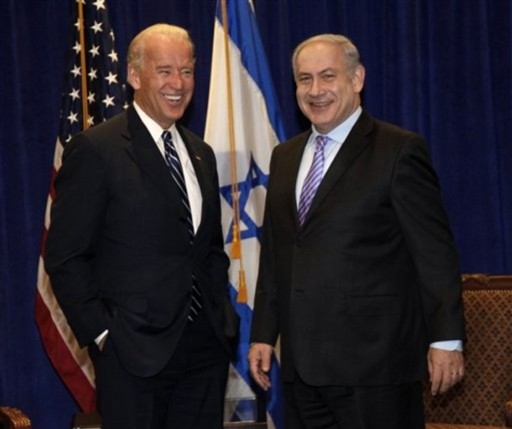
Israeli PM Benyamin Netanyau (R) meets U.S. Vice President Joe Biden on November 7, 2010 in New Orleans, Louisiana. Netanyahu is on a five day visit to the U.S. to discuss the ongoing Mideast peace process. (Photo Avi Ohayon/GPO via Getty Images)

November 8, 2010 (KATAKAMI/ YNET) --- A meeting between Prime Minister Benjamin Netanyahu and US Vice President Joe Biden ended late Sunday night in New Orleans. The two discussed Israel's desire to provide a credible threat against Iran.

The leaders also spoke of the direct peace talks between Israel and the Palestinians, the Israeli claim being that as long as the Palestinians have recourse to an indirect route, such as the UN, they will not behave seriously in talks. (*)

PM Netanyahu tells Biden: Peace agreement must not be forced on us from above


Vice President Joe Biden meets with Israeli Prime Minister Benjamin Netanyahu at the annual General Assembly of the Jewish Federations of North America in New Orleans, Sunday, Nov. 7, 2010. (Getty Images)

Prime Minister Benjamin Netanyahu meets with U.S. VP Joe Biden on sidelines of Jewish General Assembly in New Orleans; says that Palestinians must be stopped from taking unilateral action to establish a state.

November 08, 2010. NEW ORLEANS (KATAKAMI / HAARETZ) --- Prime Minister Benjamin Netanyahu met with U.S. Vice President Joe Biden on Sunday night to discuss Iran and the peace process with the Palestinians, beyond the immediate question of the settlement construction freeze, sources said Sunday.
They said the two leaders addressed what must be done so that the peace process will move forward, including security arrangements needed. 

Netanyahu said there must be an agreement that is not forced on the parties from above and that the Palestinians must not attempt to circumvent negotiations by declaring statehood through the United Nations, the sources said. 

Netanyahu and Biden were speaking on the sidelines of the Jewish Federations of North America's annual General Assembly convention, held in New Orleans this year. 

The sources said Netanyahu spoke about the need to get Arab countries involved in the Israeli-Palestinian peace process, because that will give Israel a security buffer and political backing.
Netanyahu denies that there is a rift between Israel and the United States, or between Israelis and American Jews, according to the sources. 

He reportedly said that the U.S. Congress was positive toward Israel before the November 2 midterm elections and will be positive toward Israel afterward as well. He said there is also fundamental support for Israel within the United States, saying, "We may have lost Thomas Friedman, but I don't think we lost America," according to the sources. 

As in the past, Netanyahu said that Israel has done enough to prove that it is serious, while the Palestinians have not taken any steps to demonstrate their seriousness about peace, the sources said. 


Unfriendly welcome 


Participants in the GA who listened to local radio in New Orleans on Sunday could have heard Scott Sekulow, a Messianic Christian who was born Jewish and calls himself a rabbi, who praised Netanyahu, enthused over Foreign Minister Avigdor Lieberman for standing up to the Europeans, and declared that the Palestinian refusal to recognize Israel as a Jewish state shows that they don't have peaceful intentions. Sekulow is raising money to plant 1,000 trees in the Golan Heights to replace trees that he said were destroyed by Katyusha rockets during the Second Lebanon War in 2006. 

Amidst the conference hotels straddling Canal Street where GA sessions are being held, the 4,000 Jewish leaders and activists have also confronted a less-than-friendly welcome from a group of demonstrators holding placards accusing Jews of killing Jesus and anti-Semitic chants referring to the theft of private investor money by convicted Ponzi scheme operator Bernard Madoff. One demonstrator wore an apron made of a blood-stained Israeli flag. The GA participants didn't seem overly upset by the spectacle and mounted police were on hand to maintain order. 

The results of this month's American midterm elections were the grist for hallway conversation at the GA, and there were also a number of people who asserted that Jewish life in the United States could not be reduced to the tenor of relations between the Prime Minister's Office and the White House.


(*)

Photostream : Israeli PM Benyamin Netanyahu meets U.S. Vice President Joe Biden


Israeli PM Benyamin Netanyahu (R) meets U.S. Vice President Joe Biden on November 7, 2010 in New Orleans, Louisiana. Netanyahu is on a five day visit to the U.S. to discuss the ongoing Mideast peace process. (Photo Avi Ohayon/GPO via Getty Images)

U.S. Vice President Joe Biden (L) speaks with Israel's Prime Minister Benjamin Netanyahu during a meeting on Middle East security in New Orleans, Louisiana November 7, 2010. Netanyahu will tell Biden on Sunday that only a credible military threat can deter Iran from building a nuclear weapon, Israeli political sources said. (Getty Images / REUTERS/Lee Celano )

Israeli PM Benyamin Netanyau (R) meets U.S. Vice President Joe Biden on November 7, 2010 in New Orleans, Louisiana. Netanyahu is on a five day visit to the U.S. to discuss the ongoing Mideast peace process. (Photo Avi Ohayon/GPO via Getty Images)

Israeli PM Benyamin Netanyau (R) meets U.S. Vice President Joe Biden on November 7, 2010 in New Orleans, Louisiana. Netanyahu is on a five day visit to the U.S. to discuss the ongoing Mideast peace process. (Photo Avi Ohayon/GPO via Getty Images)

Sunday, November 7, 2010

Incentives for settlement freeze likely on agenda as Netanyahu heads for U.S.


File photo : US Secretary of State Hillary Clinton looks on as Israeli Prime Minister Benjamin Netanyahu speaks before a meeting in Washington, DC, on August 31, 2010. The Obama administration geared up for a bold bid to relaunch direct Palestinian-Israeli peace talks and clinch a peace deal within a year as Middle East leaders arrived in Washington. (Photo by JEWEL SAMAD/AFP/Getty Images)

Netanyahu envoy arrived in Washington earlier this week to meet chief Palestinian negotiator on ways to renew negotiations.

November 07, 2010 (KATAKAMI/ HAARETZ) --- Prime Minister Benjamin Netanyahu was due to leave for the United States Saturday night to address the Jewish Federations' General Assembly in New Orleans.


Netanyahu will not be meeting President Barack Obama, who is in India, but he will meet with Vice President Joe Biden and Secretary of State Hillary Clinton. 

The Americans are expected to tell Netanyahu that their package of diplomatic and security incentives is still on the table if he agrees to renew the freeze on construction in the settlements. 

Netanyahu's flight to the U.S. reportedly cost the state more than $1 million, because it is a direct flight from Ben-Gurion International Airport to New Orleans. El Al was selected to fly the prime minister without a tender. 

The administration's involvement in the Middle East peace process has been almost nil in recent weeks as they attempted to shore up support at home ahead of last week's midterm elections. 

However,Netanyahu's envoy Isaac Molho arrived in Washington three days ago for a meeting with chief Palestinian negotiator Saeb Erekat on ways to renew negotiations and possibility of refreezing construction in the settlements. 

Molho made no progress, but Erekat and the Americans agreed that the Palestinians would wait until the end of November before making another move, such as approaching the UN Security Council with a demand to recognize a Palestinian state within the 1967 borders. 

Palestinian Authority President Mahmoud Abbas' spokesman Nabil Abu-Rudeina, told Agence France Presse that the Palestinians had given the Americans another three weeks to reach understandings with Israel. If no agreement was forthcoming by that time, they would approach the Security Council. 

Senior American officials, who asked to remain anonymous because of the issue's sensitivity, told Haaretz at the end of the week that during Netanyahu's visit another attempt would be made to address the construction freeze gambit. 

"Talks with Molho were serious although no solution was found, and we are still trying," an official said. 

The incentive package the Americans offered Israel two months ago includes advanced fighter planes and other security aid, as well as guarantees of a U.S. veto of any attempt at a unilateral Palestinian declaration of statehood in the Security Council in the coming year. 

Although the Americans are reportedly angry at Netanyahu's refusal to restart the freeze, they apparently do not want to clash with him at this time. 

Both Biden and Clinton are expected to press Netanyahu into renewing the freeze and show willingness to move ahead on the issue of borders, but will not accuse him of responsibility for the impasse. 

Israeli sources familiar with the U.S. position said American enthusiasm for offering incentives has cooled and that "the formulation of the letter with the guarantees has changed and Netanyahu will not be able to make do with a new two-month freeze." 

Netanyahu did not convene the forum of seven senior ministers before he left, but spoke with some of them individually. 

He will be meeting this evening at 8 P.M. Israel time with Biden, who will also be addressing the general assembly. 

Netanyahu will leave for New York immediately after his address to the GA tomorrow, to meet with U.N. Secretary General Ban Ki-moon. 

On Wednesday and Thursday, Netanyahu will meet with senior American economists, industrialists, Jewish leaders and with U.S. Middle East envoy George Mitchell. He will also give a number of television interviews. 

On Thursday, Netanyahu is to meet with Clinton. 

Defense Minister Ehud Barak, Minority Affairs Minister Avishay Braverman and opposition leader MK Tzipi Livni (Kadima ) will also be attending the GA. 

On Tuesday, Egyptian intelligence chief Omar Suleiman and Foreign Minister Ahmed Aboul Gheit will come to Washington, following separate visits to Ramallah and Tel Aviv over the past 10 days. 

The Egyptians, who are working to help Washington restart direct talks between Israel and the Palestinians, are pressuring both sides. 

The Egyptian leaders will meet with Clinton a day before she meets with Netanyahu. 

Washington think tanks have been discussing the best way for Obama to reach a breakthrough. David Makovsky, of the Washington Institute for Near East Policy said in a speech last week that if Israel wants to avoid a U.S. accusation of responsibility for an impasse with the Palestinians, Netanyahu should change his coalition and include Kadima.

(MS)

Photostream : Egyptian Intelligence Chief Omar Suleiman visits Israel


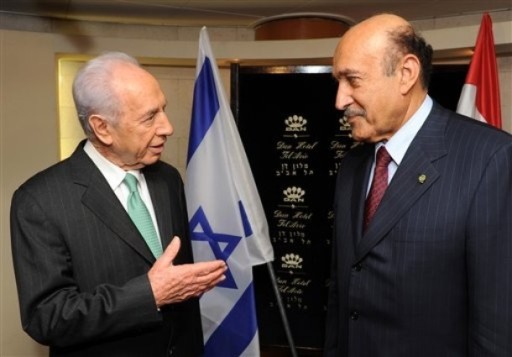
Israeli President Shimon Peres, left, shakes hands with Egyptian intelligence chief Omar Suleiman during their meeting in Tel Aviv, Israel, Thursday, Nov. 4, 2010. Suleiman met with Israeli officials Thursday, among them Prime Minister Benjamin Netanyahu, to discuss ways to boost stalled Mideast peace talks with the Palestinians. (Getty Images / AP Photo/Debbie Hill, Pool)

Israeli President Shimon Peres, left, shakes speaks with Egyptian intelligence chief Omar Suleiman during their meeting in Tel Aviv, Israel, Thursday, Nov. 4, 2010. Suleiman met with Israeli officials Thursday, among them Prime Minister Benjamin Netanyahu, to discuss ways to boost stalled Mideast peace talks with the Palestinians. (Getty Images / AP Photo/Debbie Hill, Pool)

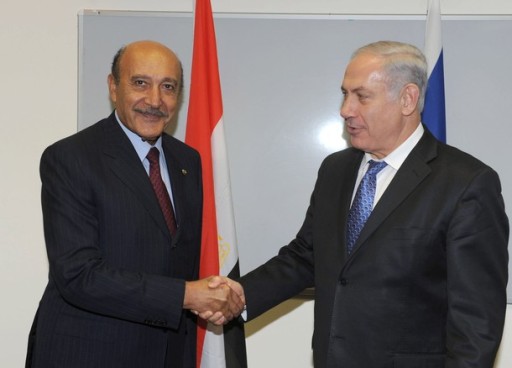
Israeli PM Benyamin Netanyau (R) meets with Omar Suleiman, head of Egyptian Inteligence on November 04, 2010 in Tel Aviv, Israel. Egyptian intelligence chief Omar Suleiman visits Israel to meet with President Shimon Peres and Prime Minister Binyamin Netanyahu to discuss the possibility of renewing negotiations with the Palestinians. (Photo by Moshe Milner /GPO/Getty IMages)

Thursday, November 4, 2010

PM Benjamin Netanyahu: Palestinians not ready for peace


Israel's Prime Minister Benjamin Netanyahu attends a session of the Knesset, the Israeli parliament, in Jerusalem November 3, 2010. Netanyahu said on Wednesday he would meet Secretary of State Hillary Clinton during a U.S. visit next week in addition to previously announced talks with Vice President Joe Biden. (Getty Images / REUTERS/Ammar Awad )

November 03, 2010 (KATAKAMI / YNET) --- During debate titled 'The world against Israel – how the Netanyahu administration isolated Israel in the international arena,' PM says, 'Rejecting Israel's right to exist doesn't advance reconciliation.' MK Bar-On: Bold decision required.

Prime Minister Benjamin Netanyahu attended a special Knesset debate titled "The world against Israel – how the Netanyahu administration isolated the State of Israel in the international arena." A request to hold a discussion on the matter was signed by 40 Knesset members, including Amir Peretz, Eitan Cabel and Daniel Ben-Simon.

First to speak was MK Ronnie Bar-On (Kadima), who slammed Netanyahu. "Before you go off to a visit in the US you should sit down and read Thomas Friedman, the most prominent US commentator. 

Maybe this time the sound of danger suggested in his articles will sound clearer. In the first round he called our leadership 'drunk drivers.' In the second round, he claimed the cabinet was inhabited by lunatics. Friedman's words point to bad times of changes in Israel's relations with the US and it's not because of any particular president."

Bar-On repeated President Shimon Peres' statements calling for an immediate political decision. "Do you need a clearer warning sign? You know, it's never too late to fix things. Make a bold, uncompromising decision and go for it. We'll be there for you and for ourselves."

MK Yohanan Plesner (Kadima) said, "You've been running the country for a year and eight months, what decision have you made except create one committee after the other. Shunning responsibility is not leadership; it's a weak, indulgent and irresponsible government."

Freeze on hold

Addressing the stalled peace talks with the Palestinians, Netanyahu said, "Rejecting Israel's right to exist certainly doesn't advance reconciliation between the nations and our desire to bring about a peace agreement. The Palestinians made an official commitment in this regard – as part of the Wye agreement and other agreements. I promise to discuss this commitment during the process, but for now I want the process to move forward without preconditions.

"If (the process) fails, it will be because the Palestinian Authority is trying to bypass the negotiations and move the process to the international track," he said.

As for the public uproar surrounding the yeshiva student bill, Netanyahu said, "We are doing exactly what has been done for the past 30 years. The haredim are part of our nation, and should be treated as such. This public should be encouraged to work."   


Likud MK Ofir Akonis responded to the Kadima claims and said, "Your Alzheimer's is really advanced. You decided to take a cynical, political ride on the backs of Israeli students," he said. "Have you no shame – to insinuate that Israel is to blame for the Marmara flotilla?"


Akonis noted that substantial stipends were given to haredim during the Kadima administration and presented a newspaper with the title: "Livni to Shas: Receive NIS 1 billion (about $280 million)." He was then escorted from the podium by security guards for violating Knesset protocol. Later, Kadima's Yoel Hasson was also removed from the hall after verbally attacking MK David Rotem (Yisrael Beiteinu).

MK Nissim Zeev (Shas) addressed the Labor MKs and said: "You can’t crush the coalition from the inside because of problems with your party chairman. I have unresolved business with the defense minister. I think he made a fool of himself, with the Galant document, with his foreign worker…they caught the most dangerous terrorist in the world – Virginia." 

Earlier this week, Netanyahu addressed the peace process during a Likud faction hearing at the Knesset. When asked about the possibility of the resumption of settlement construction freeze he replied there was no concrete US proposal and that the matter was on hold.

(MS)