Showing posts with label Pope Benedict XVI. Show all posts

Tuesday, November 9, 2010

In Spain, Pope calls Europe to open itself to God


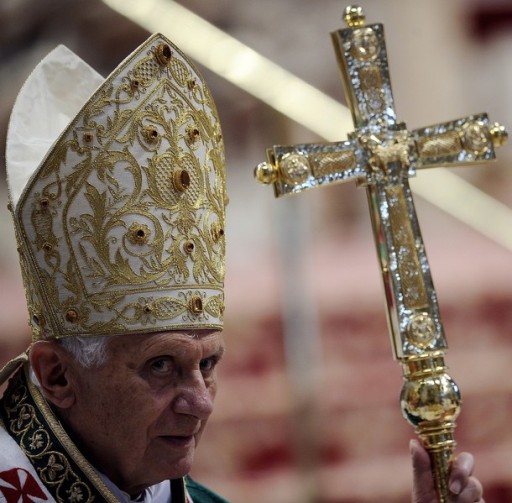
Pope Benedict XVI walks with his pastoral staff outside the Sagrada Familia church in Barcelona, Spain, Sunday, Nov. 7, 2010. The Pope consecrated La Sagrada Familia, the Barcelona landmark designed by Antoni Gaudi, whose construction began in 1882 and continues today. (Getty Images / AP Photo/Osservatore Romano, HO)

Barcelona, Spain, Nov 8, 2010 / 08:11 pm (CNA/EWTN News).- Pope Benedict XVI used his weekend pilgrimage to Spain, Nov. 6-7, to outline his vision for the "re-evangelization" not only of Spain, but of Europe and the West.

From his first words to his last, the Pope’s message was focused on drawing from Spain’s Christian roots — the great legacy of saints such as John of the Cross, Teresa of Avila, Ignatius of Loyola, and Francis Xavier — and nourishing what he called a “faith sown already at the dawn of Christianity, one which blossomed and grew in the warmth of countless examples of holiness, giving rise to countless institutions of beneficence, culture and education.”

The Pope set the tone for his trip on the flight to Santiago. He spoke of what has emerged as a central theme of his pontificate, the “challenge of secularism” in the West and the need for the Church to confront it.

In his arrival speech, the Pope once more sounded the theme: “I too wish to encourage Spain and Europe to build their present and to project their future on the basis of the authentic truth about man, on the basis of the freedom which respects this truth and never harms it, and on the basis of justice for all, beginning with the poorest and the most defenseless,” he said. “A Spain and a Europe concerned not only with people’s material needs but also with their moral and social, spiritual and religious needs, since all these are genuine requirements of our common humanity and only in this way can work be done effectively, integrally and fruitfully for man’s good.”

Although Spain still counts nearly three-quarters of its population as Catholic, less than 15 percent of the nation's more than 40 million people participate in Church life.

Pope Benedict hit repeatedly on the importance of upholding the value of human life in all forms, especially those who are most vulnerable as a key part of the Catholic message to a secularized society.
Medicine should never be used in ways that are disrespectful for human life and dignity, the Pope explained. He called for state aid for the “sacred and inviolable” lives of children from the moment of their conception. He also encouraged social and economic assistance for women so that they can find “full development” at home or work, support for men and women in their marriages, and assistance for growing families.

Strong and faithful families are necessary to the future and vitality of society, the Pope said, calling "the renewal of the family as society's fundamental cell" the "great theme" of today.

In a Mass celebrated for 7,000 faithful in Santiago's Obradoiro Square on the first day of the trip, the Pope used his homily to again urge a renewed struggle against secularism. "Europe must open itself to God, must come to meet him without fear, and work with his grace for that human dignity which was discerned by her best traditions," he said.

There is a need, he added, “to hear God once again under the skies of Europe.” He hoped that “this holy word not be spoken in vain,” and that it would not serve purposes other than its own. “It needs to be spoken in a holy way. And we must hear it in this way in ordinary life, in the silence of work, in brotherly love and in the difficulties that years bring on.”

In Barcelona on the second day of the journey, during the dedication Mass to consecrate the altar of the Basilica of the Sagrada Familia, Pope Benedict drew inspiration from the architect Antoni Gaudi's vision in building his masterpiece. He referred to the dedication of the church as “an event of great importance” in the context of “a time in which man claims to be able to build his life without God, as if God had nothing to say to him.”

Gaudi's masterpiece "shows us that God is the true measure of man, that the secret of authentic originality consists ... in returning to one’s origin which is God," said Benedict XVI.

In Santiago, the Holy Father spoke of the Church as a companion of man on the journey in search of truth, "yearning for complete fulfillment."

The words that followed could be considered the core of his message for the "new evangelization" of Spain and the West. The Church's mission, he said, is "to be among men and women an ever greater presence of Christ."

Analysts said the Pope’s words found a welcome among the Spanish faithful. Father Daniel Lorenzo, who heads a Spanish Church commission on art and culture, took part in the celebrations at the Cathedral of Santiago de Compostela. He told CNA that the Pope's message was one asking the people to live in an ever more intense communion within the Church and also with him as the Successor of Peter.

The Pope called them to return to the faith, "with rigor, " Father Lorenzo said, and after Mass, "to approach these times and the future with strength and courage, united in the faith and in dialogue with God."

Having attended the consecration of the newest basilica in the Catholic Church, Fr. Juan Rubio Fernandez, director of Spain's Catholic Magazine "Vida Nueva," told CNA that the act was "very symbolic" in being an important religious act in a "highly secularized area." It was a call to courage to all Spanish to live their faith openly, not "defending" it but "proposing" it to society, he said.

To live and transmit the message of transcendence, considering something beyond this earth, is thus a type of "goal" Spain's Catholics have taken from the act, he added. The dedication Mass also had strong symbolism for society as proof that faith and secularism can live together and have a common place in society, he said.

And, while this message has been pronounced by the Pope during other trips to widely secular parts of Europe like London, Paris or Prague, giving it in Barcelona, where there is a "strong impulse to the aggressive secularism is significant," said the priest.

In this context, he said, the Church's new evangelization through the new pontifical council does not wish to be a new form of "crusade," rather, it is "a rebirth of the faith." 

(*)

Saturday, November 6, 2010

Pope heads to liberal Spain to press church agenda


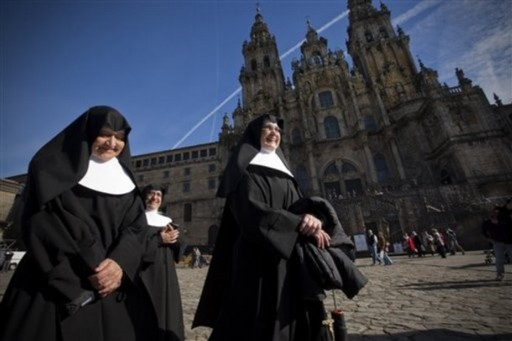
Nuns walk through the Obradoiro square in front of the Cathedral of Santiago de Compostela, background, Spain, on Friday, Nov. 5, 2010. Pope Benedict XVI will visit the pilgrimage city of Santiago de Compostela on Nov. 6 to celebrate his Holy year. (Getty Images / AP Photo/Lalo R. Villar)

November 06, 2010 VATICAN CITY (KATAKAMI / AP)  – Pope Benedict XVI begins a pilgrimage to Spain on Saturday to visit two of Christianity's most spectacular sites, fulfilling a long-held personal wish while pressing his bid to revive the faith in a once-staunchly Catholic country that is now among Europe's most liberal.

Benedict arrives first in Santiago de Compostela, Spain, a medieval and present-day pilgrimage site whose ornate cathedral is said to hold the remains of St. James the Apostle.

He wraps it up on the other side of the country in Barcelona, where he'll dedicate the famous albeit unfinished Sagrada Familia church — and face a gay "kiss-in" expected to draw thousands.

With such opposition palpable, it's no coincidence that Spain's Socialist Prime Minister Jose Luis Rodriguez Zapatero will only see Benedict as he's leaving on Sunday night. Laws under Zapatero's watch allowing gay marriage, fast-track divorce and easier abortions have deeply angered the Vatican.

In Zapatero's place, Spain's royal family will take care of the protocol meeting and greeting functions during the two-day visit.

The Rev. Federico Lombardi noted that Benedict had long hoped to make a pilgrimage to Santiago with his brother, Monsignor Georg Ratzinger, but they never got a chance and now Ratzinger is too old and frail to travel.

Millions of the faithful every year take part in the "Camino de Santiago" pilgrimage to the western Galician city — even more so in this jubilee year, which occurs every time the feast of St. James — July 25 — falls on a Sunday.

The scallop shell symbol of St. James, ubiquitous around the city, is particularly important to Benedict: it forms the central part of his papal coat of arms.

"From the beginning of my pontificate, I have tried to live my ministry as the successor of Peter with the sentiments of a pilgrim," Benedict said in a message last month to pilgrims at the Santiago sanctuary.
In Santiago, Benedict will do as the pilgrims do — embrace a statue of the apostle in the cathedral, pray before his tomb, and watch as the cathedral's enormous "botafumiero" incense burner swings pendulum-like across the length of the transept.

He'll also celebrate a Mass in the plaza outside. As many as 200,000 people are expected to travel to Santiago to see the pontiff, packing the square and cobblestone streets of the city's beautiful old quarter.
Tensions rose even before the pope arrived, as riot police swinging truncheons clashed Thursday night with anti-papal protesters in Santiago, some of whom carried red banners reading "I am not waiting for you."
In Barcelona, where Benedict arrives Saturday night, hundreds of people staged a peaceful nighttime rally Thursday against the visit, with banners decrying everything from the cost of hosting the pope to the pedophile priest scandal that has rocked the Vatican.

The centerpiece of Benedict's visit to Barcelona is the dedication Sunday of one of Spain's greatest architectural marvels, Antoni Gaudi's Sagrada Familia church.

The Vatican says the Mass in Barcelona could draw as many as 100,000 people who will witness as the church — over 100 years in construction and still unfinished — is declared a basilica.

Gaudi, one of Catalan's star modernist architects, was killed in 1926 when he was run over by a tram, leaving his life's work woefully unfinished. He is on the path to possible sainthood, though Benedict isn't expected to make any major announcements during his visit, Vatican officials say.

Thousands of gays and lesbians plan a kiss-in in the pope's presence as he leaves the grounds of the city's actual cathedral on Sunday morning, puckering up en masse to protest the conservative pontiff, whose opposition to gay marriage is well known.

The protests are clear indications of how the influence of the Catholic Church in Spain has waned in the decades since conservative dictator Francisco Franco died in 1975. After Franco's rigid social and political constraints came an explosion of hedonism and cultural vigor that has horrified the Vatican and spurred this second of three planned trips by Benedict to the country.

For many liberal Spaniards, though, the church's association with the Franco regime has been a cause for much of the alienation.

(MS)

Sunday, October 24, 2010

Pope Benedict: Mideast peace is possible, urgently needed


Pope Benedict XVI leaves a procession by 180 members of the clergy from the Middle East in St.Peter's Basilica at the Vatican on October 24, 2010. The Holy father urged all sides in the Middle East not to give up on peace and appealed for religious freedom to be respected as he wrapped up a two-week synod of bishops from the middle eastern region. (FILIPPO MONTEFORTE/AFP/Getty Images)

October 24, 2010 VATICAN CITY (KATAKAMI / CENTREDAILY.COM) — Pope Benedict XVI on Sunday called for greater religious freedom in the Middle East and said that peace there is possible, urgently needed and the best remedy to the exodus of Christians from the region.


Bishops attend a Mass celebrated by Pope Benedict XVI on the occasion of the conclusion of the synod of bishops from the Middle East in St. Peter's Basilica at the Vatican, Sunday, Oct. 24, 2010.
Benedict celebrated Mass in St. Peter's Basilica on Sunday to mark the end of a two-week meeting of Mideast bishops, called to discuss the future of embattled Christians in the largely Muslim region.
He called freedom of religion "one of the fundamental human rights, which each state should always respect" and said the issue should be the subject of dialogue with Muslims.

The pontiff said that, while freedom of worship exists in many Mideast countries, the space given to the actual freedom to practice "is many times very limited." Expanding this space, he said, is necessary to guarantee "true freedom to live and profess one's faith."

The exodus of the faithful from the birthplace of Christianity has been a major theme of the meeting, which gathered about 185 bishops from Latin and Eastern rite Catholic churches across the region and from the diaspora. In addition, two imams and a rabbi were invited to address the synod.
The Catholic church has long been a minority in the Middle East but its presence is shrinking further as a result of conflict, discrimination and economic problems.

Benedict said many Christians living in the Middle East are in discomfort either because of poor economic conditions or because of the "discouragement, the state of tension and sometimes of fear" they live in.
"Peace is possible. Peace is urgent," Benedict said in his homily. "Peace is also the best remedy to avoid the emigration from the Middle East."

In their final communique issued Saturday, the bishops demanded that Israel accept U.N. resolutions calling for an end to its "occupation" of Arab lands, and told Israel it shouldn't use the Bible to justify "injustices" against the Palestinians.

While the bishops condemned terrorism and anti-Semitism, they laid much of the blame for the conflict squarely on Israel. They listed the "occupation" of Palestinian lands, Israel's separation barrier with the West Bank, its military checkpoints, political prisoners, demolition of homes and disturbance of Palestinians' socio-economic lives as factors that have made life increasingly difficult for Palestinians.
The Israeli Foreign Ministry spokesman criticized the bishops' statement that Israel shouldn't use the Bible to justify "injustices" against the Palestinians.

"This has never been a policy of any government in Israel so this position sounds particularly hollow," Yigal Palmor said Sunday. "Let he who has never sinned cast the fist stone."

Palmor also said Israel is the only Mideast country whose Christian population is growing, and called on Christians not to flee the region. "Israel views their presence in the Middle East as a blessing and regrets their decline in Arab countries," he said.

According to statistics he provided, there were some 151,700 Christians in Israel last year, compared with 132,000 in 1999 and 107,000 two decades ago.

Also Sunday, Benedict announced that the 2012 synod would be dedicated to the theme of evangelization. The pontiff has recently created a new Vatican office - the Pontifical Council for the New Evangelization - to revive Christianity in Europe, part of his efforts to counter secular trends in traditionally Christian countries.

Wednesday, October 20, 2010

Pope says Church’s mission a duty of every Catholic

Pope Benedict XVI


Vatican City, Oct 20, 2010  (CNA/EWTN News).- Pope Benedict XVI said that World Mission Sunday is an opportunity for Catholics to to reflect on the Church’s mission to bring Christ’s message and love to “every people, culture, race and nationality.”

Authentic Christian mission recognizes that God’s love cross all geographical borders and boundaries of culture, the Pope said in a message prepared for the annual day of prayer and promotion of the Church’s missionary activity, to be celebrated this year on Oct. 24.

“The Father calls us to be sons and daughters, loved in the beloved Son, and to recognize that we are all brothers and sisters in (Christ), who is the gift of salvation for humanity,” the Pope reflected.
The Pope said that while “discord and sin” divide humanity, members of the Church are called to bear witness by the example of their lives and to promote a “new humanism founded on the Gospel of Jesus.” The demonstration of authentic love, he said, gives credibility to the words of the Gospel, both in its historic centers and in remote lands.

This proclamation of God’s love in Christ, he emphasized, is “a duty of the whole Church” which is “by her very nature missionary.” While some individuals experience a particular call to proclaim this message as clergy, catechists, or lay missionaries, others participate in the universal mission to “offer signs of hope and to become universal brethren.” In all circumstances, he said, “the Gospel is a leaven of freedom and progress” and “a source of brotherhood.”

Pope Benedict stressed that the task of foreign missions “cannot be fulfilled without a … community and pastoral conversion” involving “all diocesan and parish communities.” The local church’s celebration of the Eucharist, he explained, both calls and enables its members “to promote the proclamation of the Gospel in the heart of … every people, culture, race and nationality in every place.”

Pope Benedict expressed special gratitude of “missionaries who bear witness to the coming of the Kingdom of God in the most remote and challenging places, often with their lives.” Describing them as the “vanguard of the Gospel’s proclamation,” he urged all members of the Church to support the work of the Pontifical Missionary Societies through prayer and the gift of their resources.

Pope names 24 new cardinals

Pope Benedict XVI

October 20, 2010 VATICAN CITY (KATAKAMI / MSNBC.COM / AP) — Pope Benedict XVI has named 24 new cardinals, including a large number of Italians, two Americans and prelates for key posts in Europe, Latin America, Asia and Africa.

The new cardinals include Archbishop Donald Wuerl of Washington, D.C., and Archbishop Raymond Burke, an American who leads a Vatican court and has been sharply critical of the Democratic Party in the United States for its support of abortion rights.

The pope made the announcement Wednesday, putting his mark on the body that will elect his successor.
Other key posts were Warsaw, Munich, Kinshasa, Quito, Lusaka, Zambia, and Sri Lanka.

Tuesday, October 19, 2010

In personal letter to seminarians, Pope says priesthood is ‘great and pure’


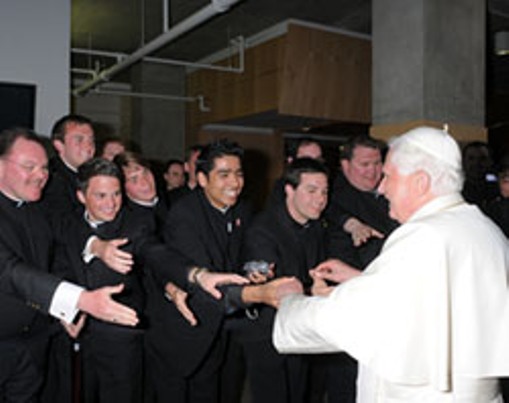
Pope with seminarians
Vatican City, Oct 18, 2010 / 04:50 pm (KATAKAMI / CNA/EWTN News ).- In an often personal letter to the world’s seminarians, Pope Benedict XVI said the recently surfaced scandals of priest sexual abuse “cannot discredit the priestly mission, which remains great and pure.”

His letter to men training for the priesthood was issued Oct. 18 to mark the close of the special “Year for Priests,” that ended in June.

The Pope compared the “difficult times” of today with the climate in the final months of Nazi regime in Germany when he was a young man. He recalled that when he was drafted for military service in December 1944, the commander asked him about his plans for the future.

“I answered that I wanted to become a Catholic priest,” the Pope said. “The lieutenant replied, ‘Then you ought to look for something else. In the new Germany priests are no longer needed.’”

The Pope said he knew then, just months before Hitler’s death and the Nazi surrender, that after “the enormous devastation which that madness had brought upon the country, priests would be needed more than ever.”

Today too, he said, men studying for the priesthood face skepticism that their ministry is no longer needed in a new age “marked by technical mastery of the world and globalization.”

For many, “the Catholic priesthood is not a 'job' for the future, but one that belongs more to the past,” he said.

But that is not true, Pope Benedict said. “You have done a good thing,” in entering seminary, he told the future priests.

“Because people will always have need of God … They will always need the God who has revealed himself in Jesus Christ, the God who gathers us together in the universal Church in order to learn with him and through him life’s true meaning and in order to uphold and apply the standards of true humanity.”

The Pope’s letter included a detailed and often personal exhortation to seminarians on the role of the priesthood and the spiritual maturity that it requires.

The priest must first and foremost be a “man of God,” who is willing to grow in self-knowledge and “humility” through prayer, the Pope said. He encouraged the seminarians to cultivate an “inner closeness” with Jesus through the sacraments, especially the sacrament of Penance.
This sacrament is vitally important to the spiritual formation of priests, he said.

“It  teaches me to see myself as God sees me, and it forces me to be honest with myself …” the Pope said. “Moreover, by letting myself be forgiven, I learn to forgive others. In recognizing my own weakness, I grow more tolerant and understanding of the failings of my neighbor.”

The Pope also urged seminarians  to foster “the right balance of heart and mind, reason and feeling, body and soul, and to be humanly integrated.”

“This also involves the integration of sexuality into the whole personality,” he said. “Sexuality is a gift of the Creator yet it is also a task which relates to a person’s growth towards human maturity. When it is not integrated within the person, sexuality becomes banal and destructive.”

“Recently we have seen with great dismay that some priests disfigured their ministry by sexually abusing children and young people,” the Pope added. “Instead of guiding people to greater human maturity and setting them an example, their abusive behavior caused great damage for which we feel profound shame and regret.”

“Yet even the most reprehensible abuse cannot discredit the priestly mission,” Pope Benedict stressed, “which remains great and pure.”

Sunday, October 17, 2010

Photostream : Pope Benedict XVI canonises six new saints


Pope Benedict XVI waves as he arrives to lead a solemn mass for the canonisation of Stanislaw Soltys, Andre Bessette, Candida Marï¿?ï¿?ï¿?de Jesus Cipitria y Barriola, Mary of the Cross MacKillop, Giulia Salzano, Battista Varano in Saint Peter's square at the Vatican October 17, 2010. (Getty Images / REUTERS/Tony Gentile )

Pope Benedict XVI attends a Canonisation ceremony in St Peter's square, on October 17, 2010 in Vatican City, Vatican. The pontiff today named six new Saints; Stanislaw Soltys, Andre Bessette, Candida Maria de Jesus Cipitria y Barriola of Spain, Mary of the Cross (Mary Helen) MacKillop, Giulia Salzano and Battista Camilla da Varano. (Photo by Franco Origlia/Getty Images)

In this picture made available by the Vatican newspaper Osservatore Romano, Pope Benedict XVI shakes hands with Australia's Foreign Minister Kevin Rudd inside St. Peter's Basilica, at Vatican, Sunday, Oct. 17, 2010. The Pontiff gave Australia its first saint on Sunday, canonizing a 19th-century nun and also declaring five other saints in a Mass attended by tens of thousands of people. (Getty Images / AP Photo/Osservatore Romano, HO)


Australian Foreign Minister Kevin Rudd (R) and deputy opposition leader Julie Bishop (L) attend the Canonisation ceremony of Australia's first Saint sister Mary MacKillop celebrated by Pope Benedict XVI in St.Peter's square on October 17, 2010 in Vatican City, Vatican. The pontiff today named six new Saints; Stanislaw Soltys, Andre Bessette, Candida Maria de Jesus Cipitria y Barriola of Spain, Mary of the Cross (Mary Helen) MacKillop, Giulia Salzano and Battista Camilla da Varano. (Photo by Franco Origlia/Getty Images)

Archbishop of Australia Cardinal George Pell (C) arrives for a canonisation ceremony includes Australia's first Saint, Sister Mary MacKillo, celebrated by Pope Benedict XVI in St. Peter's Square on October 17, 2010 in Vatican City, Vatican. The pontiff named today six new Saints; Stanislaw Soltys, Andre Bessette, Candida Maria de Jesus Cipitria y Barriola of Spain, Mary of the Cross (Mary Helen) MacKillop, Giulia Salzano and Battista Camilla da Varano. (Photo by Franco Origlia/Getty Images)

Pilgrims hold pictures of new saints, Australian Mary of the Cross MacKillop (L) and Canadian Andre Bessette, as Pope Benedict XVI leads a solemn mass for the canonisation of six new saints in Saint Peter's square at the Vatican October 17, 2010. ( REUTERS/Tony Gentile )

Australian pilgrims hold banners featuring the portrait of Australia's first Saint Sister Mary MacKillo during a canonisation ceremony celebrated by Pope Benedict XVI in St. Peter's Square on October 17, 2010 in Vatican City, Vatican. The pontiff named today six new Saints; Stanislaw Soltys, Andre Bessette, Candida Maria de Jesus Cipitria y Barriola of Spain, Mary of the Cross (Mary Helen) MacKillop, Giulia Salzano and Battista Camilla da Varano. (Photo by Franco Origlia/Getty Images )

A tapestry showing new Canadian Saint Andre Bessette hangs from Saint Peter's Basilica as Pope Benedict XVI leads a solemn mass for the canonisation of six new saints in Saint Peter's square at the Vatican October 17, 2010. (Getty Images / REUTERS/Tony Gentile )

Saturday, October 16, 2010

Pope meets President of Poland on anniversary of the election of John Paul II

Pope Benedict XVI (R) greets Poland's President Bronislaw Komorowski during a private audience at the Vatican on October 16, 2010. (Photo : PIER PAOLO CITO/AFP/Getty Images)

October 16, 2010 (KATAKAMI / VATICAN RADIO) — Pope Benedict today received the President of Poland in private audience here at the Vatican. The meeting came on the 32nd anniversary of the election of the Polish born Cardinal Archbishop of Krakow, Karol Wotjtyla w as the successor of Peter.

A statement released by the Vatican Press office noted the “happy coincidence” of the visit on this anniversary and went on to say that both the Pope and President focused on the importance of dialogue between Church and State, in order to promote the common good.”

They also “reiterated their common desire” to see both Poland and the Holy See ” continuing to work effectively in areas of common interest, such as in education and promoting the fundamental values of society, and stressing the importance of protecting human life in all its phases. “

Finally, according to the statement there was “an exchange of views on the current situation in Europe.”
After the private talks there was an exchange of gifts in a more informal atmosphere.

President Komorowski gave the Pope a facsimile manuscript of the music of Frédéric Chopin, whose bicentenary is being celebrated this year.

The Pope in return gave the President a medal of his pontificate.

Before the meeting with the Holy Father, President Komorowski participated on Saturday morning at a Mass celebrated in the Vatican Grottoes, at the tomb of John Paul II.

After the Mass, the head of state and his wife knelt in prayer before the tomb of the Polish Pope and laid a bouquet of white and red flowers, the colours of Poland

Australia's first saint Mary Mackillop to be canonised

Workers hang a tapestry featuring the portrait of new saint Mary MacKillop on the balcony overlooking St. Peter's Square on October 16, 2010 in Vatican City, Vatican. Pope Benedict XVI will name blessed sister Mary MacKillop known also as Mary of the Cross, as Australian first Saint in a Canonisation ceremony in St. Peter's square on next Sunday. (Photo by Giorgio Cosulich/Getty Images) 


October 16, 2010 (KATAKAMI / BBC) –  Australia’s first saint – a 19th-century nun who was briefly excommunicated is to receive official recognition.

Pope Benedict will canonise Mary Mackillop in a service at the Vatican in Rome.

Her work for the Church was sometimes controversial and in 1871 she was excommunicated for insubordination.

The Church exonerated her three years later and she was eventually put on the road to sainthood by Pope John Paul II, who beatified her in 1995.